Archive for the ‘controversial’ category

Swimming With Tigers…

October 12, 2012

– – There’s a rather controversial and disconcerting experience that’s becoming quite the rage in some circles; swimming with tigers!

For a fee of $200 for a half hour romp, a private Florida zoo is offering the public a chance to swim, play in the grass, and bottle feed Tony, an eight-week-old tiger cub at Dade City’s Wild Things zoo outside of Tampa, Florida.  Now tigers like Tony are only allowed to swim with visitors until they weigh 40 pounds, and once they hit 25 pounds, must be on leashes.  At least one of the trainers is also in the water with the visitor.  As an option, visitors can also swim with alligators who have had their mouths taped shut.

Some animal rights activists are not amused, finding it abusive and dangerous to the animals’ health since they can be awakened repeatedly for anyone who will “pay to play”…and in Congress, two pieces of legislation are pending that would prohibit the private possession and breeding of big cats.


News With Bite, Too!

August 7, 2012

– – Talk about having a terrible, no good, really bad day!   Wallace Weatherholt, a 63-year-old airboat captain in the Florida Everglades, was giving a tour of the area on June 12th to an Indiana family and hanging fish over the side of his boat when a nine-foot alligator sank its teeth into his wrist, severing his hand.
The mutilated captain drove the boat back to its dock with one hand, and was promptly taken to the hospital.  His severed hand was found in the alligator’s stomach, but could not be reattached.  Six weeks later, the airboat captain was charged with feeding an alligator, a second-degree misdemeanor.  Arrested, Weatherholt faces a fine of up to $500 and a possible jail sentence.  He posted $1,000 bail since his arrest, and will appear in court later in August. 

The alligator was tracked down by officers of the Florida Wildlife Commission, and put to death shortly after the attack.  Laws against feeding alligators are intended to protect both animals and humans, as alligators when fed lose their fear of humans…

Dead Cat Helicopter?

June 9, 2012

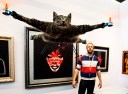
– – Me-ouch!  Call me old fashioned, but I’m not too keen on the idea of turning a deceased cat into a mini-helicopter, finding the idea unsettling and perhaps gruesome; I like bizarre and creepy, but in a good way.   PETA likewise dislikes the notion, with a spokesman calling the postmortem transformation “…a macabre way to honor a beloved family member.”  The artist, however, sees the visual exhibit as paying tribute to his cat, who now can soar with the birds that he loved.

The male cat appropriately named Orville died following a less than positive encounter with a car about six months ago.  His Dutch artist owner taxidermied the skin, encased it in polyester, and put a propeller on each of the four outstretched paws.  A remote control device enables the cat-quadcopter to fly.  The end product has been called creepy, sick, or hilarious, depending on one’s perspective.  The Orvillecopter has been on display at an art fair in Amsterdam, although Dutch animal lovers and the Dutch animal welfare party have heavily criticized the exhibit…

…the late cat, Orville, has a brother, Wilbur, who is still alive.  Both  animals were named after the Wright brothers of aviation fame.

Mongrels!

March 1, 2012

– – Think The Muppets meet Family Guy, and you’ve got a starting idea of what the show Mongrels is like!  This British sitcom revolves around the lives of five anthropomorphic animals who hang around the back of a pub in London.  I’m an easy sell for the show as one of the main characters is Nelson, described as a likeable middle-class urban “metrosexual fox.”  Other regular characters include an Afghan hound, a borderline-retarded cat, a pigeon, and another sociopathic, foul-mouthed fox. The pilot of the show also included a suicidal chicken!

 Definitely not for the wee ones, the show features neutering, incontinence, cannibalism, and catnip overdoses!  The show was described as attempting to do for puppetry what American shows like The Simpsons have done for animation.  The show, which took five years to make, ran on the BBC for two seasons between 2010 and 2011, but sadly was not renewed for a third season due to poor viewing figures.  Episodes and clips of Mongrels may still be viewed on Hulu and YouTube,  and Nelson has a page on Facebook as well as another promoting him for Prime Minister…what a fox!  


“Diving Horse” Revival Scrapped…

February 27, 2012

– – In times gone by, New Jersey’s fabled Atlantic City featured at their Steel Pier a so-called “diving horse” act which began in the 1920’s, and was shut down five decades later.   In the stunt, a horse ascended to the top of a 40-foot platform, and didn’t as much dive as was tipped off it, plunging the animal and its rider into a 12-foot deep water tank below.   Animal rights advocates maintained that the act at the very least scared horses, and carried the potential for them to be injured or even killed.

A brief return of the act happened in 1993 with riderless mules substituted for the horses, but protests ended that revival.  Nostalgia for Atlantic City’s edgy past prompted recent plans for another diving horse comeback, but successful online petitions against the plan caused the revival rather than the horses to be tanked…

Doomsday Reprieve?

December 4, 2011

 – – Alright, it looks like you may be able to relax a bit on December 21, 2012 after all!   That was supposedly the date when the Mayan Long Count calendar ran out, and all heck was supposed to break loose, culminating in the end of the world as we know it or hopefully at least of Facebook

Anyways, never mind!  A revisionist Mayan archaeology expert,  Sven Gronemeyer, says that his interpretation of certain hieroglyphs on a 1,300 year old  stone tablet found at Tortuguero in the Mexican province of Tabasco indicates that the 12/21/2012 date indicates the reappearance on Earth of the Mayan god of creation and war, Bolon Yokte, who will usher in a new  era on the planet, but not necessarily a destructive one.

That’s certainly a load off my mind!  I plan on putting together a nice fruit basket for the returning god, and then maybe we can organize a friendly soccer game or something…

Language Applied to Animals…

May 4, 2011

– – I most resent the word “varmint” when applied to foxes and other animals; it’s degrading and disrespectful, and dates back to a time when animals were treated unkindly as little better than things; sadly, some still hold this viewpoint.  Language is a curious and powerful thing, and the label that we apply to a living creature shapes how it is permissible to treat them.  As a tool of classification, language then also becomes a device of control.

Researchers from the Oxford Center for Animal Ethics along with the University of Illinois and Penn State University suggests that using such words as “varmints,” “critters,” and “beasts” to describe animals degrades the relationship that can exist between them and humans by contributing to a mindset of animals being trivial, unfeeling, and inconsequential.   Instead, a language should be cultivated that shows mutually respectful relationships between humans and the animals which live among them.  I’m fully on board with all of this…

…where we separate the sheep from the goats (so to speak) is in the beliefs of some animal rights academics that pets should be renamed “companions,” and that rats are just “free-living;”  pigeons are simply “free-roaming.”   While I do consider my co-habiting animals as companions, this is my personal choice, and I happen to be an animal myself (this is not necessarily a bad thing)!  When political correctness kicks in, however, it’s often time to take a holiday before things get silly and I’m expected to garb my animal companions in clothing, which they would hate anyways.

What can perhaps be taken away from all of this is the thought that words are powerful, not because an animal understands the nuances of language or cares what you call them but because words can influence how your mind works, with language choice subsequently affecting human behavior towards animals as well as countless other things.  If you doubt this, consider that psycholinguistics has been at the core of every successful political campaign for the last number of decades, with labels determining perceptions and serving as a substitute for independent critical thought for many…

New Aflac Duck…

April 30, 2011

 – – Say it ain’t so…the Aflac duck’s been canned!  Or at least the voice of comedian Gilbert Gottfried is following jokes he made on Twitter about the earthquake and tsunami in Japan.  Aflac, incidentally, gets 75% of its revenue from Japan, so Gilbert was history.

The new voice of the Aflac duck is Daniel McKeague, an advertising sales manager from Minnesota.  He reportedly will be getting a sum in the low six figures for a one year contract, one which is likely to be renewed

…maybe I could sing opera for a J.G. Wentworth commercial!

Stun Gun Hunting?

April 14, 2011

– – As technology continues to advance, it can lead us into ethical considerations previously unconsidered and perhaps unexplored that were in the past gray areas at best.  One such area is that posed by the possibility of the stun gun hunting of animals...

The value of Tasers and other electronic stun devices has been well established in police work and security applications as a non-lethal way of subduing and controlling non-compliant suspects.  Likewise, one can readily see the potential value of a Taser Wildlife Electronic Control Device such as has also been developed as a non-lethal way of immobilizing wildlife that has perhaps blundered into a human habitation area where its presence poses potential danger both to the animal itself as well as to humans present.  This non-lethal weapon can temporarily incapacitate moose, bears, and other large animals, and could be helpful to park rangers and wildlife officials; it’s a heavy-duty device which packs quite a wallop and costs about $2,000.

A disturbing question that has arisen is whether such a weapon might be used deliberately by private individuals seeking to practice “catch-and-release” hunting.  While it is unclear whether stun guns have already been used for this purpose, the potential for such abuse is real.  While stunning an animal without need is preferable to shooting it, such an action could easily be considered cruelty.  Human test subjects who have experienced stun guns almost universally describe the experience as painful and unpleasant, and the United Nations considers stun guns instruments of torture as they inflict pain.

The state of Alaska is accordingly moving to proactively outlaw the use of stun guns to zap wild animals for “catch and release” hunting in the state.  The weapon may still be used defensively, in emergency situations, or for purposes of further research by trained professionals.  State biologists have been using electronic animal control devices in Alaska since 2005.  Additionally,  while wild animals usually flee when hit with the current, there is no guarantee that they will do so…and one does not want to severely aggravate a grizzly!


Biting Humor?

February 20, 2011

– – I like dark humor and black comedy, but they’re not everyone’s cup of tea.  For this reason, the recent Snickers great white shark commercial has rubbed some shark conservationists and shark attack victims and their families the wrong way, plus done little to dispel the erroneous notion that humans are the preferred food source for sharks.

In the commercial, a group of well-animated and voiced-over CG great white sharks are participating in a focus group where they are questioned about a “blind taste test” of people that they have just eaten.  The preferred victim is revealed to have eaten Snickers Peanut Butter Squared, while the less tasty victim had consumed peanut butter cups.

Now the commercial is intended to be comical, harmless, and light-hearted rather than educational and sensitive, and is a vehicle intended to entertain and linger in the mind so as to sell more Snickers products.  Some contend, however, that the ad was released too close on the heels of actual shark attacks in Egypt and elsewhere, and has accordingly gone too far.- -Sick or slick?  You decide!