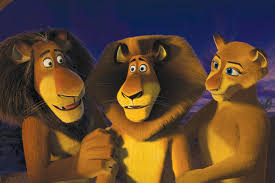
In commemoration of Father’s Day, we bring you Alex the Lion dancing both solo and with his Dad from the film Madagascar: Escape 2 Africa!
Alexthe Lion is initially displaced from Kenya to become a performer in the Central Park Zoo in New York City, and when displaced from that environment becomes a fish out of water, although one equipped with impressive dancing skills that he uses to quell a group of starving stranded tourists in Madagascar from NYC intent upon having him for dinner! Convinced of his true identity, Alex escapes his predicament through the power of his art…
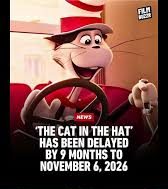
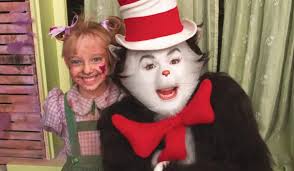
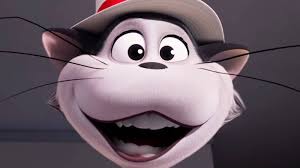
Originally intended for an earlier 2026 release, a new animated version of the Dr. Seuss classic, The Cat in the Hat is now projected to open in November of 2026 to better capitalize on the Christmas trade. It should be better received than the 2003 live action version of the story that featured Mike Myers…
Sometimes referred to as “The Cat who Fell Flat,” the 2003 movie was I think a better film than it’s often credited to be, although it’s a bit crass, and the humor is rather “out there.” A sequel was originally intended, but the widow of Dr. Seuss so disliked the film that she forbid live action films of her husband’s work to ever again be made. The successful How the Grinch Stole Christmas (2000) predated The Cat, and was a winner with Jim Carrey.
Believe it or not,the title role in The Cat in the Hat live action movie was originally intended for Tim Allen, but he had a conflict so the part went to Myers, who was a pretty big box office draw having done the Shrek films and the Austin Powers series. It’s really hard for me to imagine Tim Allen as the character despite his many talents, and I think that Myers brought the required manic energy to the part. While the makeup was a bit creepy, he did look more like a cat than the strange hybrid “cats” of the movie musical version of Cats. The 2003 live-action film adaptation faced heavy backlash for featuring adult-oriented humor that alienated family audienceswith adult double entendresand crude potty humor, and some have gone so far as to suggest that the Cat’s visual design and performative tricks are rooted in 19th-century blackface minstrelsy…but I think that this is an extension too far…
I still love The Cat in all of his incarnations, anyways, who in this 2026 film appears appropriately enough to be on a reclamation proving mission for himself, risking losing his “stripes” (iconic hat) if he fails. The Cat is my fave Dr. Sseus character, before and after The Grinch achieved massive popularity. This Cat is modern, in touch, and slick, without any apparent adult content; you can be hip, appealing, and funny without being dirty! He’s resilient, too, gettingmaced in the eyes upon his initial contact by the kids he’s trying to help.– – Welcome to 2026, Cat! If the Cat can find redemption, dare we hope that Pepe Le Pew is not far behind?!
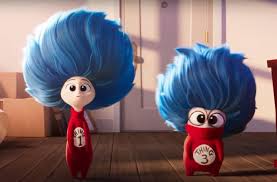
This animation is friendly to the Cat in the Hat character, which was originally translated from the classic 1957 children’s book to an animated TV special in 1971. The upcoming 2026 film comes from Warner Bros. Pictures, so it has a good pedigree. Maybe we’ll have a Thing or Two to say about it, with the Things in this film revealed to be more than a duo…the talking fish is there, too…
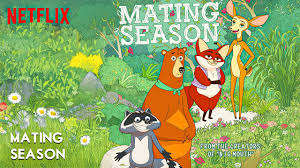
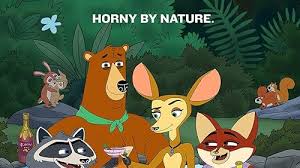
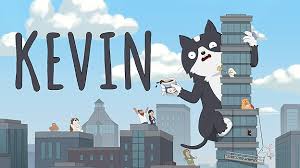
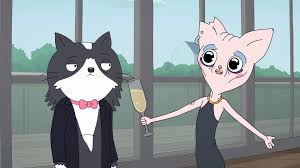
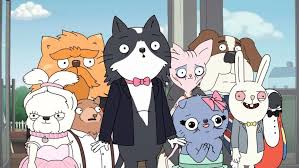
With a title such as “Mating Season” and a cast of anthropomorphic cartoon animals, you may rightfully have a suspicion of what the show is largely about. Your second clue comes with the realization that the new 10-episode first season show on Netflix is produced by Titmouse, the same studio that gave us Kevin, about the anthropomorphic tuxedo cat trying to find himself in the big city after his human owners break up, and essentially dump him in an animal shelter…
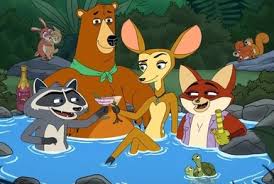
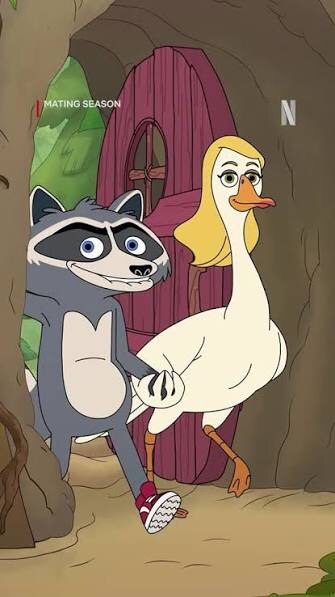
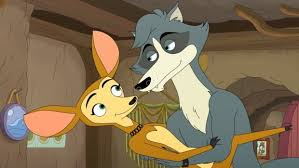
“Kevin” is Shakespeare, however, compared to “Mating Season.” This show is RAUNCHY, and definitely NOT FOR CHILDREN! I cannot shoutthat from a sufficiently tall enough building. Not only do the denizens of an anonymous forest have sex, but they have it often, and with others outside of their own species! Struggling a bit to relate a somewhat sanitized version of a central occurrence in episode 1, a hyperactive, highly sexualized male raccoon named Ray winds up sharing intimacies with a flirty female skunk, and in the aftermath of that, they wind up with a “copulatory tie,” joined together at the genitals until later in the episode…
(Picturedabove; Ray, Josh, Fawn, and Penelope…)
Now I do know that raccoons are stereotypically among the bad boys of the furry fandom, and that the fandom has always had a “yiffy” component, but I worry a bit that some outside of the fandom are going to see all of the highly sexualized animals on parade here, and think that’s mostly all that the fandom is about. It took us a long time, for example, to put the CSI episode featuring fursuits behind us…
The artwork in Mating Season is good, as is characteristic of Titmouse studios, and far better than most of the mass-produced cartoons on television. We need to consider, however, the messaging conveyed by such an adult cartoon. The show is unapologetically vulgar, and emphasizes shock value at the expense of character development. It’s strangely reassuring, however, to learn that I am still capable of being shocked, almost to the point of feeling violated as a furry. I do not enjoy wallowing in the mire; we furries are better than this! 😼
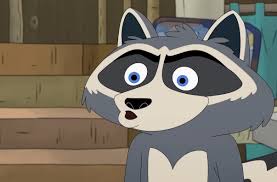
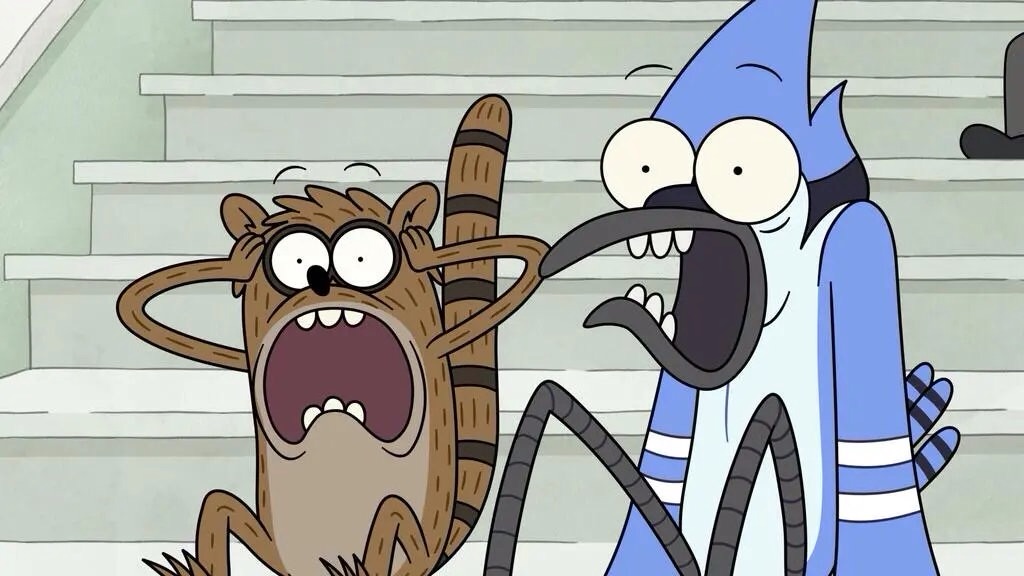
I mean, Rigby the raccoon of Regular Show (below) would be shocked by Ray the raccoon, and that’s saying something! 🙀
Nowin all fairness to the series, episodes beyond the initial one do seem to be slightly tamer, and we can sense the closeness of the animal community. There’s quite a variety of different species represented, such as Penelope the lesbian fox, her straight friend Fawn the deer, Josh the bear deserted by his mate, Dylan the wolf, and Summer the lesbian hound, who has an intense but doomed relationship with Penelope.So beyond the sexuality, the series deals with relationships, and the difficulties inherent in them. For example, the wolf moves in with the deer, but they split up as the wolf urinates everywhere to mark his territory, and invites his pack to a real “animal house”-styled celebration of the full moon, complete with drinking and howling….
Now this is cute; furries are actually directly referenced in the series (I believe in episode 3), and some of the animals play at being human! Turn-about is fair play, I guess. So perhaps I was initially too harsh on the series out of my initial shock, and Mating Season can be quite funny and clever if you’re OK with the vulgarity and strong sexual content…it’s just not for everyone, and definitely for adults only…
Amazon Prime’s adult animated series “Kevin” featuring anthropomorphic animals is highly polarizing to viewers, with one review terming it “unpleasant, unfunny, and unwatchable,” while others have found it “heartwarming!” But as a furry and cat lover, I had to check this out…
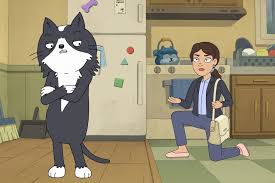
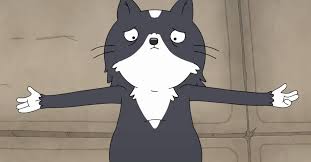
At the heart of Kevin is an anthropomorphic neurotic tuxedo cat (voiced by Jason Schwartzman) who loses his home when his humans break up, casting him into a local pet rescue center in Queens called “Furrever Friends” filled with “independent” animalswhere he encounters a number of homeless and displaced animals, predominantly felines, most of which are even more disordered and scarred by life than he is. Take for example “Cupcake,” voiced by Whoopi Goldberg, who portrays an emaciated, battered, and battle-scarred feral catwho is fearless, cynical, and yet quite adept at surviving in the environs of New York City…
…and man, the animals in the city are tough! His feral instincts triggered, Kevin chases a squirrel who in turn pulls a knife on him! A half-dead pigeon begs Kevin to eat him to put him out of his misery (thankfully, he refuses)! These are not cutesy animals, but rather hardened, grim individuals who provide the inexperienced, once pampered house cat with an education in the “School of Hard Knocks.”
Make no mistake, this is NOT a cartoon series for children! The language is generously sprinkled with vulgarities and obscenities, and the animals are raunchy, and at times quite twisted. There is humor here, but it’s quite dark. There is a content advisory for “nudity, violence, substance use, alcohol use, smoking, foul language, sexual content, and flashing lights and strobing patterns that might affect photosensitive viewers.”- – Something for everyone, right?! As a furry I like all things furry, but this series at times pushes the boundaries into rather extreme territory that will turn off many. The series explores the question of finding where you belong in the world, which is something that most of us will ultimately contend with. It just won’t be everyone’s cup of tea, but that’s why we have buttons to change the channel or turn sets off…
All eight episodes of the first season of Kevin may be streamed from Amazon Prime, and I’d consider it an acquired taste…you’ll either love it or hate it, but it may grow on you…
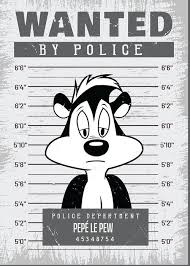
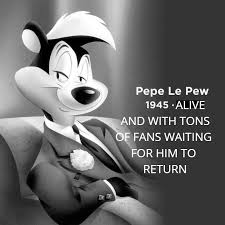
I would be remiss if I did not remind you that January 6th is the birthday of Pepe Le Pew, by my estimation his 81st as the character was introduced in 1945 in the cartoon, Odor-able Kitty. My question is what to buy Pepe for the occasion…an industrial-strength can of Glade room freshener, perhaps?
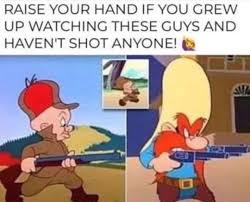
While Pepe now languishes in what I’ve heard referred to as Horny Prison due to unwanted romantic advances towards one Penelope Pussycat, I curse cancel culture and the fact that Elmer Fudd and Yosemite Sam are allowed to freely brandish and discharge guns while Pepe is not allowed to pursue his natural instincts, even if they are unwelcomed and misguided…
His birthday is an appropriate time to remember our romantically self-deceived skunk, and appeal for the reformation and re-appearance of his character in some form. I know that males foistering their unwanted romantic intentions on another is wrong, and that times have changed enormously since 1945…but surely a reconstituted version of the character is possible, and that fans would welcome his return in some form…
Although it’s entirely possible that in light of his age, Pepe may have entirely lost interest in the Game of Love to begin with…
So celebrate and rememberPepe Le Pew on his natal day, N’est-ce pas?
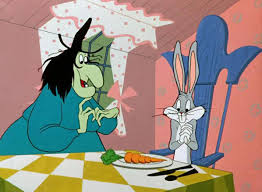
With Halloween nigh, I thought it might be appropriate to pay a Foxsylvania tribute to Witch Hazel, one of Warner Bros. mildly darker characters lightened by her humor and self-parody of witches in general. Witch Hazel is almost reminiscent of the Warner Bros. character of Granny, but turned slightly to the dark side…
Created by Chuck Jones in 1956, Witch Hazel was reportedly inspired by the witches of Shakespeare in Macbeth, but considerably more comic. Viewers knew that Witch Hazel would never actually eat children, nor defeat Bugs Bunny. Hansel and Gretel did actually appear in Bewitched Bunny featuring Witch Hazel, but Bugs handily thwarted her, masquerading as a truant officer to gain access to the witch’s abode. Hazel then tried to feed Bugs a poisoned carrot, but that didn’t go as planned for her, either…he’s apparently unintentionally rescued by Prince Charming in another crossover from fairy tales!
At the end of that episode, Bugs employs an accessed magic powder to turn the witch into a rather winsome female rabbit, walking off arm in arm with her. Breaking the fourth wall to address the viewing audience, Bugs informs us that he knows that this is a witch, but asks us if they (females) aren’t all witches inside! (*breath-taking gasp!*) Dialogue like this would probably not pass muster in today’s politically correct age…
( I don’t care, the female rabbit is still hawt! )
I have always had an interest in and appreciation for vintage cartoons, not to disparage the modern product ( although some “limited animation” ‘toons are poorly drawn and abominable). It’s just that when we look back on some of these efforts stemming back to the early days of animation, we can appreciate how clever, wildly creative, and groundsbreaking they truly were…
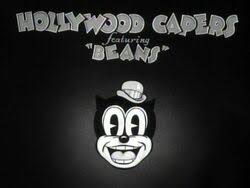
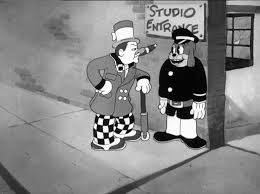
One such example is the 1935 Looney Tunes cartoon Hollywood Capers (featuring Beans). Now Beans (one of the Boston Beans, he tells us) is a black cat properly attired in overalls and a too-small hat who sneaks into a production studio, and we meet cartoon versions of Charlie Chaplin and W.C. Fields along the way.- – How sad that such classic characters are becoming increasingly unknown to many people!
Now Beans creates all kinds of mischief in the studio, even meeting the Frankenstein Monster, who was almost a current issue at the time that this cartoon was made…
So take the time to view some early vintage ‘toons, which can have the sensation of being an acid trip sans drugs. They are wildly remarkable for their time…
I, for one, think that it’s time that Warner Bros. rehabilitates and brings back Pepe Le Pew, the hopeless romantic French skunk. Created by Chuck Jones and first appearing in 1945, the character was caught in a firestorm a few years back for his signature behavior of foisting his unwanted amorous intents upon females, specifically one Penelope Pussycat…
I get it! What was perfectly laughable and largely acceptable behavior in 1945 isn’t now, and Pepe needs to be and could be re-imagined and re-introduced, perhaps as a defender of women or as a bonded mate to a now equally-loving Penelope; portray him as a chastened now successful relationships counselor, even! We just lost a lot when Pepe was banished to cartoon purgatory…
Pepe was lovable, and had a certain charm. He satirized French culture and the stereotype of the great French lover, blinded by his own misperceptions of his desirability; the joke was always on Pepe, who because of his skunk-odor wasn’t desirable, and was hitting on a member of another species entirely, failing to discriminate such. Pepe had a cluelessness that was relatable and even endearing. He never successfully scored, unless you count unreciprocated kissing as that…and face it, there are very few cartoon skunks in the field!Heck, with his repellent scent, re-brand him as a kind of superhero or police officer. Imagine, for a moment, the Pepe and Penelope crime fighting team!
So how about it, Warner Bros? Why does Pepe Le Pew suffer harsh sanctions when the Mango Mussolini does not? Free Pepe Le Pew from his cartoon prison, and re-introduce the boy as someone who’s learned his lesson, and changed! – – It can be done!
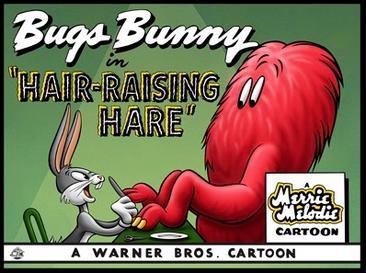
With Halloween coming, our attention turns (more than usual) to monsters, and an underrated cartoon monster is Gossamer, a creation of Chuck Jones who first appeared in the 1946 Warner Bros. cartoon, Hair-Raising Hare.Gossamer has a heart-shaped head and face, and is completely covered in reddish-orange hair, his only clothing a large pair of white or gray-white tennis shoes…
NowGossamer is a creature of indeterminate species and sex, originally intended as an antagonist to Bugs Bunny, who quickly exploits Gossamer’s attraction to girly-type things like manicures and hair make-overs. Gossamer is also handily defeated even by Porky Pig in his space-cadet identity in service to Daffy Duck, calmly using a monster hair-clipper…of Acme manufacture, of course!And surprise…Porky’s clipper reveals that Gossamer is entirely made of hair!
Gossamer is essentially a paper tiger, so to speak, and while usually a hulking giant seen lurking in Gothic-type castles or even on Mars, he actually has a hidden shy and sensitive nature, and is more scared of people than you are of him. Enjoy the following compilation of Gossamer’s greatest moments that follows, and watch for a cartoon version of Peter Lorre right at the beginning!
Tex Avery was an animation geniuswho rebelled against many traditions, creating in Screwball Squirrel a deliberately unlovable character who was intended to be a satire of cute, sentimental cartoon characters such as were often seen in Disney productions. Also known as Screwy Squirrel, this rodent was aggressively chaotic and obnoxious, and appeared only in five theatrical shorts between 1944 and 1946 before being discontinued as Avery himself grew to find the character annoying, and disliked him! This was not an affable, cutesy, or nice squirrel…
Screwy was really manic and wild, and so you might say that there were elements of Daffy Duck and the much later Roger Rabbit in him, but without any redemptive or likeable features. Screwy would actively torment a dim-witted dog called Meathead, and bring about the unseen but clearly implied destruction of other characters that he found offensive…
(“Disney-esque”squirrel versus “Screwy…”)
Screwball Squirrel meets his apparent death in a 1946 cartoon when he is crushed to death by a hug from a spoiled, dim, and emotionally-needy dog called Lenny. Since death is seldom permanent in cartoon characters, however, Screwy who “don’t move no more” appears at the end of the feature holding up a sign reading, “Sad ending, isn’t it?” The aggressively chaotic character would much later be seen in the 1990’s TV series “Droopy, Master Detective” and “Tom and Jerry...”
You must be logged in to post a comment.