Archive for the ‘science’ category

Artificial Jellyfish!

July 28, 2012

– – I’m sure that you’ll all be pleased as punch to learn that scientists in the U.S. have created a free-swimming artificial jellyfish!  I, for one, know that when at the ocean, I can never have enough of them bumping against me in the tide or lying on the beach.

It gets stranger, too; the team members built the replica using silicone as a base on which to grow heart muscle cells that were harvested from rats.  They then used an electric current to shock the created Medusoid into swimming with synchronised contractions that mimic those of a real jellyfish!  I swear that I am not making this up…

The finding serves as proof of concept for reverse engineering a variety of muscular organs and simple life forms.  As jellyfish use a muscle to pump their way through the water, the way that they function is similar on a basic level to that of a human heart.  Such similarities reveal what you need to do to design a bio-inspired heart pump.

Synthetic life is an emerging field of science that until now focused on replicating life’s building blocks.  Now instead of just building a cell, researchers at Caltech and Harvard University have built a beast!  

The “Real” Naked Mole Rat…

July 5, 2012

– – The real naked mole rat is even less attractive than the CG one featured in a recent MiO commercial, featuring wrinkled skin, stubby legs, and poor eyesight.  This rat native to East Africa is however a longevity champ, living 10 to 30 years as opposed to the three year life span of the common rat.  Although not  pretty, the rat also ages well, showing little of the slow decline in mental and physical health commonly associated with aging.  “Senior” naked mole rats maintain high levels of physical activity, strong bones, and can even continue to reproduce in their golden years!

The reason for this according to new research conducted in the U.S. and Israel seems to be unusually high levels of the NRG-1 protein, which is thought to protect the integrity of the body’s nerve cells.  This research could lead to new insights about human aging, and lest we feel too superior to them, rodents’ genes are 85% similar to humans!

Attack of the Killer Shrimp!

May 2, 2012

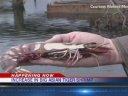
– – Some people have bucket lists of things that they want to do before they “kick the bucket,” that is, die…but I have a list of things to be worried about or afraid of, and I’ve just added something to that list…Run, ’cause there’s an invasion of Asian Tiger Shrimp!  I can see a Saturday night movie on the SciFy channel coming out of this, folks…

Now Asian Tiger Shrimp are not hideous mutants or skilled in the martial arts, although I could see them developed as potential adversaries for the Teenage Mutant Ninja Turtles. They are, however,  jumbo shrimp, which as George Carlin pointed out was an oxymoron.  These are big suckers, measuring up to thirteen inches long and weighing up to a quarter pound, and they are cannibalistic…that’s right, shrimp that eat other shrimp.- -Isn’t that redundant?

Also known as tiger prawn, the black-and-white striped creatures are showing up in the Gulf of Mexico and Southeast coast, and are preying on smaller, native sea life as well as competing for resources and carrying  diseases…a triple threat, if you will.  Scientists don’t know exactly how the Asian variety got to the Gulf Coast, but marine ecologists are looking into the shrimp’s DNA for clues, with breeding in the local waters or conveyance by ocean currents possibilities.

And if Asian Tiger Shrimp team up with Asian Carp, we could have seafood that would eat you…or at least take your computers for their young!  I’m paying protection money while I still can…

Permian Pompeii?

February 23, 2012

– – Roughly 298 million years ago, a volcano erupted in the Inner Mongolian district near the modern-day city of Wuda, China raining down volcanic ash with such intensity that a forest was quickly buried and essentially preserved in remarkable detail down to branch and leaf structure. American and Chinese  scientists have recently excavated this lost forest, ironically through coal mining activities in the region. 

The preserved forest of about 11,000 square feet gives researchers the unique opportunity to examine an ecosystem essentially frozen in time by a natural disaster dating back to when the earth had only one giant landmass known as Pangaea.  Scientists have worked with artist Ren Yugao to capture how the sites may have looked at the time…

Divine Burgers?

January 14, 2012

 – – At a restaurant aptly named Hamburger Mary’s in Tampa, Florida, an image of the Virgin Mary has been reported on a stainless steel wall near the kitchen.  Remarkably, the diner has been known for gay karaoke nights and drag queen shows. 

The mark of a superior being or saint has likewise been seen in a Walmart receipt, cheese sandwiches, candle wax, Cheetos, rocks, overturned trees, walls, pizza pans, and even on a fish stick!   Some of these items have been offered for sale on internet auction sites.  Verily, the Lord moves in mysterious ways…

The perception of religious imagery in natural phenomena is sometimes called simulacra, and studies have shown that even visual perceptions can be affected by wishes, preferences, and desires.  The human mind prefers to perceive patterns, especially the pattern of a human face, in otherwise random phenomena.  Perception of an image is additionally mediated or filtered through culture, politics, and worldview…

Rats Who Care…

December 20, 2011

 – – It’s OK to call someone a “dirty rat,”  as rats do get dirty;  it might not, however, be scientifically supportable to refer to rats as uncaring in light of a new University of Chicago study on empathy-driven behavior in rodents. 

Appearing in the prestigious journal Science, the results of this landmark study show that untrained laboratory rats will free restrained companions,  even when those restrained rats are not in pain.  Rats will even choose to free other restrained rats when offered the alternative activity of feasting on chocolate!  Greater love hath no rat than this…

The new study on rats sets a precedent for future research on sentient and empathic animals; it’s also safe based on what we know to assume that numerous other animals display empathy, which is thought to have deep evolutionary, biochemical, and neurological underpinnings. 

Findings of empathy in animals may force uncomfortable questions about how humans treat animals, especially with regards to horrific invasive research.  Birds, rats, and mice are presently excluded from some federal legislative definitions of animals, with only about 1% of the animals used in research in the United States currently protected by legislation.

Pliocene Park?

December 7, 2011

 – – I dunno if it will sound like Ray Romano in Ice Age, but Japanese and Russian scientists are working to bring back woolly mammoths via a cloning process within five years!   ‘Ya see, a mammoth thigh bone was found under permafrost soil in Siberia with its marrow in unusually well preserved condition, and a Russian/Japanese team will seek to recreate the mammoth using DNA taken from the marrow that is then put into the nuclei of eggs cells of common elephants.  Embryos so obtained would then be implanted into elephant wombs to be delivered.  Since the two species are close relatives, scientists are not foreseeing many complications.

Despite the usual cries of science running amok, this is very cool technology and an exciting prospect!

Janus Cats…

October 7, 2011

 – -They are not Photoshopped or the product of trick photography; meet Frank (left) and Louie (right), the world’s longest surviving Janus cat.  Named for the figure in Roman mythology with two faces on one head,  Janus cats seldom survive due to congenital defects that include cleft palate, often causing the afflicted animal to starve or choke to death.  Frank and Louie, however, beat the odds handsomely, using only one mouth to feed and making it to the ripe old feline age of 12 years. 

Originally taken by his breeder to be euthanized at the Cummings School of Veterinary Medicine at Tufts University, Frank and Louie were instead adopted by a worker there, and have fared well since.  Residing in Worcester, Mass. the exotic blue-eyed rag doll cat boasts two faces, two mouths, two noses, and three eyes, and is a friendly soul who walks on a leash and loves car rides…

Some “Thing’s” Coming!

September 27, 2011

 – – Wow, it doesn’t seem possible that it was way back in 1982 that John Carpenter made his version of the sci-fi/horror classic The Thing, complete with Kurt Russell as that film’s protagonist, R.J. MacReady!- –Well, some Thing else is coming this October, this version a prequel taking place three days before the events of the John Carpenter film and following the exploits of the Norwegian and American scientists unfortunate enough to originally discover the shape-shifting alien.

While it’s hard to beat Kurt Russell, the new version of The Thing includes Mary Elizabeth Winstead as Dr. Kate Lloyd, a lead character somewhat modeled after Sigourney Weaver’s Ellen Ripley in the Alien film series; fortunately, no romantic or sexual elements will be introduced associated with her character in keeping with the dark tone and paranoid atmospherics of the previous film.   Efforts have been made to keep the new film visually consistent with the 1982 Carpenter flick, and creature effects will include both animatronic and computer generated imagery.  We’ll be seeing much more of the interior of the crashed alien spacecraft, and it will also be implied what the nasty alien mimics were doing about in the galaxy.- -All in all, The Thing should serve to remind us that if we find something buried deep in the ice in Antarctica, leave it the hell alone!

I plan on seeing The Thing in October, and you may want to, as well…who knows, The Thing may become you!

Death from the Skies?

September 23, 2011

 – – Perhaps Chicken Little was on to something after all…a dead climate satellite about the size of a school bus is expected to plummet back to Earth around Friday, September 23rd or Saturday, September 24th.  While most of it will disintegrate in the atmosphere, over two dozen pieces weighing a total of about 1,200 lbs. are still expected to survive re-entry, the largest weighing about 300 pounds.  If such were to hit you on the head, it would probably ruin your whole day!

While this is the most massive NASA satellite to make an uncontrolled re-entry into Earth’s atmosphere in more than three decades, not to worry…the odds of the big nasty hitting anyone anywhere in the world are about 1-in-3,200.  The odds of you getting hit personally are on the magnitude of 1-in-21-trillion, meaning that you are much more likely to be struck by lightning or eaten by a shark than to be hit by a piece of the UARS satellite! 

Anyways, a killer satellite might really enliven an otherwise dull weekend…so “Look to the skies!”