Archive for the ‘Invertebrates’ category

Paul the Psychic Octopus…

July 10, 2010

– – We’ve talked before here on Foxsylvania about how the octopus is a smarter creature than many realize, being capable of such behaviors as learning how to open jars.–Well, some would dare say that an octopus called Paul is kind of a cephalopod Nostradamus, performing such feats as predicting the winner of the World’s Cup!

Paul the octopus resides in the Sea Life Aquarium in Oberhausen, Germany.  His predictions are made by observing which of two clear boxes marked with a national flag he decides to eat a mussel from, and he has correctly forecast the outcome of every match in which his native German home team has played as of July 8th.

With a very respectable hit rate to date in past predictions, only a sucker would bet against this octopus! – – And wouldn’t psychic cephalopod be a great name for a band?!


Beware of Bug Thugs!

June 3, 2010

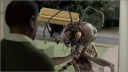
– – I, for one, am not really fond of gigantic insects, especially when they’re anthropomorphic, possessed of the power of speech, and even capable of driving cars.   These are so much more than the lumbering giant insects seen in such vintage B-flicks as the ant saga,  Themthe giant insectile creatures of Starship Troopers were a hoot, though!

…such are the awesome and disgusting ants and roaches of Orkin, appearing in televised ads right at your doorstep and even crashing your pool party!  These bugs are insidious and clever; they might be delivering a pizza that you didn’t order, or saying that they’re broken down, and need to use your telephone…in one of the latest ads, a giant cockroach shows up to leer at an amorous couple in a hot tub.  He (-it?) lets his towel drop to the floor, and asks in a wonderful voiceover if he can go “dipping skinny!”  When they are spurned and countered, the bugs peel out in a variety of cool and classic vehicles, including motorcycles!

At once both sinister and comical, these bugs are animatronic, and it reportedly takes seven guys to operate each one.  If they come to your house, don’t let ’em in…it would probably take more than a rolled-up newspaper to defeat them, and we value your readership!

Spaced-Out Spiders…

May 27, 2010

– -What happens when  poor, innocent spiders are given the active ingredient in marijuana, THC?–Well, they create a poorly-constructed minimalist web.  Since garden spiders typically build a new web every day, such impairment isn’t good.  In experiments, spiders have also been given such drugs as speed, LSD, and even caffeine.  On high doses of caffeine, for example, the regular design of the web disappears.  While on acid, the spider can’t complete his web at all…much like stoner humans who aren’t terribly productive, either…

…and nobody wants stoned spiders around their house, anyways!

Killer Slug Attack!

May 21, 2010

– – I hate it when slugs are  used as weapons; the gross-out factor alone is appreciable.- – Yet when slugs are outlawed, only outlaws will have slugs!

True Story! A man in Sweden has been found guilty of harassment  after he dumped a bag of killer slugs (Spanish slugs) into a neighbor’s garden.- -Did she tell the authorities, “He slugged me?”- –Was this assault with a deadly mollusk?  The man previously had thrown a firecracker into the woman’s garden, who had taken out a restraining order against him.  The slug in question earned the “killer” nickname due to its tendency to eat dead or weaker individuals of the species…

Remember, it’s not nice to slug your neighbors…and yes, it was a sluggish day in the news!

Squid vs. Whale Smackdown?

May 17, 2010

– – What could be cooler than a battle royal between a colossal squid and a sperm whale?–Well, maybe a three-way between the whale, giant squid, and a T-Rex, but that’s just for rich fantasies!   Sadly, even the image of the giant squid as the Kraken which attacks ships is not all that it’s cracked up to be…

Marine biologists reporting in the April issue of the Journal of the Marine Biological Association of the United Kingdom have painted a picture of a mostly sedentary creature that would wait to ambush passing fish rather than even bother to swim after them.–What a slacker squid!   As a cold-blooded creature, the colossal squid was not even great whale food; it simply wasn’t that nutritious!

I still look for colossal squid to enter the United States by coming through Arizona, evading the police, and taking  jobs that no native-born American would want…then they’ll be able to get health care!

Cockroach of the Sea!

April 3, 2010

– – They’ll never call a tuna that…but they’ve found an enormous crustacean scouring the depths of the Gulf of Mexico, a giant isopod called Bathynomus giganteus related to shrimp and crabs that measured 2-1/2 feet long and was found hooked onto the bottom of a remotely-operated vehicle at a depth of 8,500 feet!

Now most giant isopods are less than a foot long, making the recent discovery a supersized version.  This could be because of a condition called gigantism, which is thought to be common among crustaceans inhabiting especially cold water regions.   In addition to larger size, colder temperatures tend to be conducive to longer life spans, and the deeper the water, the bigger the critter.

Giant isopods are predators that feed on carcasses of dead whales and fish, and have also been known to attack sea dwellers that are alive and swimming.   Such creatures  have existed for more than 160 million years.- -Nature is scary, which is just how I like it!

“Giant Killer Bees” on MonsterQuest…

February 5, 2010

– – Whenever I hear of killer bees, I think of that wonderful old Saturday Night Live sketch with the original cast and their tacky but hilarious get-ups…bobbing antennae and all!

I’m less fond of the more mundane MonsterQuest episodes featuring such things as feral dogs, underground rats, and yes, killer bees.  It strikes me that the series is stretching for material on such episodes, expanding and sensationalizing what they have.  Killer bees are a rather old saw at this point, and only the beekeeping forums were buzzing about this one.

Don’t get me wrong; bees are awesome insects, kinda nature’s Borg collective.  Like the pythons featured in the previous episode, they’re expanding their range, and can adapt to colder northern environments by doing things like “clustering,” grouping together in the central core of their hives to conserve and share heat.

The episode just lacked the shock and awe factor of the cryptid episodes, and is more like something I’d expect on National Geographic than The Quest

Living Green!

January 14, 2010

– – Part plant and part animal, a sea slug found living in salt marshes in New England and Canada called Elysia chlorotica is the first multicellular animal found to be able to produce the plant pigment chlorophyll.   The critters can actually survive without food if a light is shined on them for twelve hours a day.- -Now that’s walkin’ on sunshine!

The slugs appear to acquire this ability by stealing genes from algae that they’ve eaten, stealing also minute cell parts called chloroplasts which enable conversion of sunlight into energy.

The slug has been studied for about twenty years, although scientists are not yet sure how the animals appropriate the genes that they need.  This is yet another example of how invertebrates can do some pretty amazing things…well, let’s see you live without food!    😉


Octopus Goes Coconuts!

December 15, 2009

– – Having taken Invertebrate Zoology , I for one have long thought that some invertebrates are smarter than what we usually give them credit for being, especially higher mollusks like cephalopods.–Well, Australian scientists have discovered an octopus in Indonesia that gathers coconut shells for shelter, behavior which researchers believe is the first evidence of tool use in an invertebrate animal!–Yeah yeah, I know about SpongeBob, but he doesn’t count…plus I find him annoying!

The scientific community has long debated about how to define tool use in the animal kingdom, being as how they don’t ordinarily have access to Black and Decker equipment.  The Australian researchers defined a tool as an object carried or maintained for future use, and the veined octopus, Amphioctopus marginatus, selected halved coconuts from the ocean floor chucked there by humans, emptied them out, carried them under their bodies for up to 65 feet, and then assembled the two halves together to make a spherical hiding spot!–Isn’t that totally cool?!–One biologist described himself as gobsmacked, an expression I’d like to see re-integrated into the popular culture…

This is different from what hermit crabs do as the octopus is collecting the shells for later use, showing a capability for complex behavior.–Respect your local octopus!