 – – We all know that parrots and mynah birds can mimic human speech. A memorable Far Side cartoon depicted a carload of cows driving past a field of wandering humans, one cow leaning out the window and mocking the “yackety-yack” speech of people. Well, it seems that we can add another species to the short list of those now know to be capable of speech mimicry..the beluga whale!
Whales are no slouches in the intelligence department, but a study recently published in Current Biology under the title “Spontaneous speech mimicry by a cetacean” really blew me away. The whale of the study, named Noc, lived at San Diego’s National Marine Mammal Foundation for 30 years before dying in 2007. It seems that handlers first heard mumbling in 1984 coming from a tank containing whales and dolphins that sounded like two people chatting far away. One day after a diver surfaced from the tank and asked, “Who told me to get out?” researchers realized that the garbled sounds came from a captive male Beluga whale. For several years, they then recorded its spontaneous sounds while it was underwater and upon surfacing.
An acoustic analysis revealed that the human-like sounds were several octaves lower than typical whale calls, and scientists think that the whale’s close proximity to people enabled it to listen to and mimic human speech by changing the pressure in its nasal cavities. Now the whale appears to be saying the word “out” over and over, and some have said that it sounds like people singing in the shower or the Muppets’ Swedish Chef.
Beluga whales, also known as white whales, are sometimes called “the canaries of the sea” because of how vocal they are. Anecdotal reports have surfaced in the past of whales sounding like humans. At Vancouver Aquarium, keepers had suggested that a white whale about 15 years of age had uttered his name, “Lagosi.” While people should not think from these results that whales can communicate with us on a conversational level, it’s an intriguing possibility for future research…
 – – While engaged in a conservation project to determine how to help turtles cross the road safely, a Clemson University student inadvertently discovered a disturbing fact: some drivers deliberately swerve on the road, not to miss turtles, but to intentionally hit them.
  – – Have you ever seen anything look this sad and cute at the same time?–Don’t you just want to take it home with you?–Well, you may not want to, because it’s a venomous primate, a type of slow loris species called Nycticebus kayan newly discovered in Borneo.
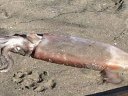 – – Hundreds of Humboldt squid beached themselves this past weekend near Santa Cruz, California. Attempts to save the squid by placing them back into the water were futile; the squid simply swam back onto the shore!
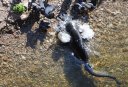 – – Too often, fish are regarded as dumber than a sack of hammers. This may not be true of all of our finned friends, however. In France, researchers at the University of Toulouse have observed catfish hunting pigeons as prey in a development scientists are calling evidence of adaptive behavior.
 – – A tragedy occurred at the Pittsburgh Zoo and PPG Aquarium late Sunday morning when a young boy visiting the zoo with his mother and friends fell off an observation deck rail into the pit of an exhibit housing 11 African painted dogs.
 – – We had earlier posted on how a Beluga whale had learned to imitate human speech, and now we may add the Asian elephant to the list of species capable of mimicking speech…in Korean, yet!
  – – Wild boars are attacking!–And please note that we are talking about the animal spelled “boar,” not “bore,” although lord knows we have an abundance of such creatures. Anyways, while Americans have been battling with Hurricane Sandy, China and Germany have been hit with wild boar attacks. In Berlin, Germany, a wild boar appeared out of the woods, and attacked four individuals before eventually being shot by a police officer. Then in Shantou, China, a boar broke into an office, in the process breaking down a glass window, smashing a water pipe, and attempting to get at a cook. The Chinese boar eventually escaped, and has yet to be found by investigators.

 FOXSYLVANIA
You must be logged in to post a comment.