 – – Wild boars are attacking!–And please note that we are talking about the animal spelled “boar,” not “bore,” although lord knows we have an abundance of such creatures. Anyways, while Americans have been battling with Hurricane Sandy, China and Germany have been hit with wild boar attacks. In Berlin, Germany, a wild boar appeared out of the woods, and attacked four individuals before eventually being shot by a police officer. Then in Shantou, China, a boar broke into an office, in the process breaking down a glass window, smashing a water pipe, and attempting to get at a cook. The Chinese boar eventually escaped, and has yet to be found by investigators.
It has been speculated that the German boar had been hit by a car prior to the attack, due to the fact that it had suffered a left front leg fracture. The notation was made that injured animals can get aggressive as a defense mechanism.
…and by the way, good readers…Happy Halloween!

 – – Described as “visually stunning” and “the next Avatar,” an upcoming November 21st movie Life of Pi is a 3D magical adventure tale based on the best-selling 2001 novel by Yann Martel which centers on Pi Patel, the 16-year-old precocious son of a zoo keeper who has an encyclopedic knowledge of animal psychology and behavior. The Indian teenager is the only human to survive the sinking of a freighter, and finds himself on a lifeboat with several animals that include an orangutan, a hyena, a wounded zebra, and a Bengal tiger. While on the surface a tale of survival, Life of Pi holds spiritual dimensions as well, although there is no preaching going on here, and more questions are raised about faith and belief than answered. Pi himself practices not only his native Hinduism but also Christianity and Islam; paralleling the story of the young man and the tiger, this is a zen-like tale about coexistence, tolerance, and the reconciliation of opposites…something the world could use more of!
 – – We all know that parrots and mynah birds can mimic human speech. A memorable Far Side cartoon depicted a carload of cows driving past a field of wandering humans, one cow leaning out the window and mocking the “yackety-yack” speech of people. Well, it seems that we can add another species to the short list of those now know to be capable of speech mimicry..the beluga whale!
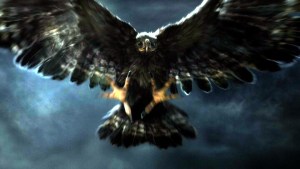 – – I, for one, worry about extremely large whiskey-swilling birds of prey terrorizing the neighborhood; they might, for example, lower already-depressed property values, to say nothing of discouraging tourism.
 – – A not-so giant mammoth excavated from the Siberian permafrost in late September 2,200 miles northeast of Moscow near the Sopochnaya Karga cape was a 16-year-old at the time of his death who stood two meters tall (6’6″) and weighed 500 kilograms (1,100 lbs). He was named Jenya after the 11-year-old Russian boy who found the animal’s limbs sticking out of the frozen mud. Jenya was missing a left tusk, a fact which handicapped him for fighting and may have contributed to his early death tens of thousands of years ago.
 – – I’m always glad when giant eyeballs wash up on beaches, bringing to mind as they do such vintage sci-fi classics as 1958’s The Crawling Eye. Eyeballs by nature tend to make people squeamish, especially disembodied ones…and in time for Halloween, too!- -What a gift from the sea!
 – – There’s a rather controversial and disconcerting experience that’s becoming quite the rage in some circles; swimming with tigers!
 – – Just when the Jurassic Park films had us hoping for such a real-life scenario, it turns out to be virtually impossible owing to the calculated half-life of DNA, which figures out to be only around 521 years.
  – – You’ve probably seen Kit-Cat Klocks,
 FOXSYLVANIA
You must be logged in to post a comment.