 – – We all know that parrots and mynah birds can mimic human speech. A memorable Far Side cartoon depicted a carload of cows driving past a field of wandering humans, one cow leaning out the window and mocking the “yackety-yack” speech of people. Well, it seems that we can add another species to the short list of those now know to be capable of speech mimicry..the beluga whale!
Whales are no slouches in the intelligence department, but a study recently published in Current Biology under the title “Spontaneous speech mimicry by a cetacean” really blew me away. The whale of the study, named Noc, lived at San Diego’s National Marine Mammal Foundation for 30 years before dying in 2007. It seems that handlers first heard mumbling in 1984 coming from a tank containing whales and dolphins that sounded like two people chatting far away. One day after a diver surfaced from the tank and asked, “Who told me to get out?” researchers realized that the garbled sounds came from a captive male Beluga whale. For several years, they then recorded its spontaneous sounds while it was underwater and upon surfacing.
An acoustic analysis revealed that the human-like sounds were several octaves lower than typical whale calls, and scientists think that the whale’s close proximity to people enabled it to listen to and mimic human speech by changing the pressure in its nasal cavities. Now the whale appears to be saying the word “out” over and over, and some have said that it sounds like people singing in the shower or the Muppets’ Swedish Chef.
Beluga whales, also known as white whales, are sometimes called “the canaries of the sea” because of how vocal they are. Anecdotal reports have surfaced in the past of whales sounding like humans. At Vancouver Aquarium, keepers had suggested that a white whale about 15 years of age had uttered his name, “Lagosi.” While people should not think from these results that whales can communicate with us on a conversational level, it’s an intriguing possibility for future research…
 – – When something has more than four legs, it generally tends to inspire a cringe factor. Something with 750 legs would definitely then register high on the creepy and gross-out scale, and this little beauty is so compact as well; a white millipede named Illacme plenipes, which is Latin for “the pinnacle plentiful feet,” and measures a mere 1 – 3 centimeters long.
 – – Shut up and eat your creamed spinach! New research has suggested that early human ancestors in central Africa 3.5 million years ago ate a diet of mostly tropical grasses and sedges before evolving a taste for meaty flesh.
 – – We had earlier posted on how a Beluga whale had learned to imitate human speech, and now we may add the Asian elephant to the list of species capable of mimicking speech…in Korean, yet!
  – – A not-so giant mammoth excavated from the Siberian permafrost in late September 2,200 miles northeast of Moscow near the Sopochnaya Karga cape was a 16-year-old at the time of his death who stood two meters tall (6’6″) and weighed 500 kilograms (1,100 lbs). He was named Jenya after the 11-year-old Russian boy who found the animal’s limbs sticking out of the frozen mud. Jenya was missing a left tusk, a fact which handicapped him for fighting and may have contributed to his early death tens of thousands of years ago.
 – – Just when the Jurassic Park films had us hoping for such a real-life scenario, it turns out to be virtually impossible owing to the calculated half-life of DNA, which figures out to be only around 521 years.
  – – They sound like the perfect subject for a Saturday night original movie on the Syfy Channel: The Vampire Squid from Hell (Vampyroteuthis infernalis). They rather look like a bad movie monster, too, having a type of cloak-like webbing, unusually large deep blue or red eyes, and light-producing organs covering its entire body which it can flash!

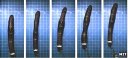 – – I, for one, will sleep more easily tonight knowing that engineers have finally built a better worm! Your tax dollars have been hard at work as engineers have created a robot that mimics a worm’s movements, and is capable of crawling along surfaces by contracting segments of its body.
 FOXSYLVANIA
You must be logged in to post a comment.