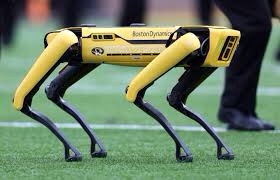
Boston Dynamics has creeped some people out with their robotic dog intended for security or military applications that looks like it might be a best friend for a T-800 Terminator.– -How, oh how, to make the uncanny Robo-dog more user-friendly, more acceptable? The answer is simple; make a furry out of it!
There!- – Isn’t that nicer? Less menacing now, our Robo-pooch looks almost like something out of Disney! You could be lulled into a false sense of security and might even invite its presence, until it can get within 30 feet of you and perhaps deploy its flamethrower attachment. Then it’s all over except for the screaming.- -Talk about an infiltrator unit! 🤖
Acceptance of robots is all about presentation, after all. So enjoy this little dance of the robot stripped down and dressed-up models. Just ask yourself, do you trust your dog?- – Do you, really? 🙀
Let me start by saying that I would be beyond excited and thrilled if living aliens or real alien corpses were actually produced. As Fox Mulder’s office poster proclaimed, “I Want To Believe.” I could die happy if positive proof of alien life were produced…
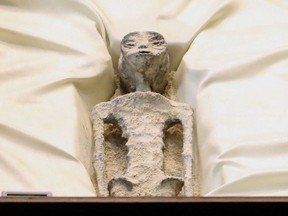
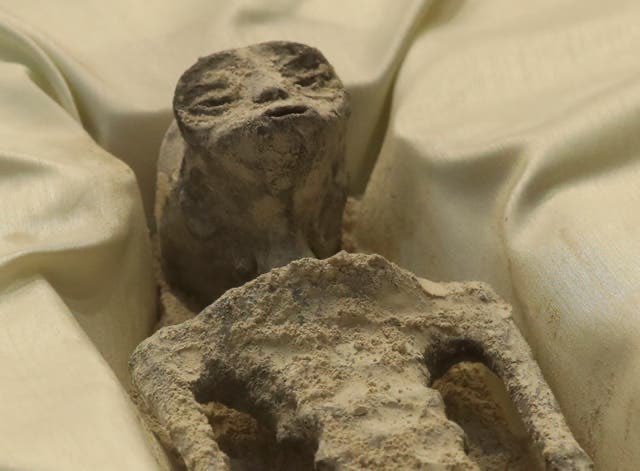
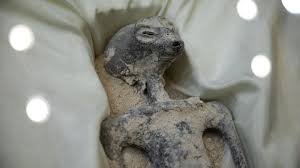
Jaime Maussan, a journalist and self-proclaimed Ufologist, recently presented to a Mexican congressional committee two supposed alien mummified “corpses” that were gray, had three fingers, bulbous heads, an “ET”-type elongated neck, and measured about 1-1/2′ in length. They were presented behind glass panels in small caskets, with the claim made that they were discovered in 2017 in algae mines in Cusco, Peru. They are supposed to be between 800 and 1,700 years old…
These “alien corpses” look phony at even casual photographic examination, and smart money holds that they are paper mache constructions overlayed on a doll body or wire armature. This makes them akin to sideshow gaffes like the “Rat Boy.”
The presenter of said defunct aliens has done such things before, unveiling in 2015 another “alien corpse” that turned out to be the remains of a long-deceased child with a head deformity.
So continue to “look to the skies,” but take comfort in the fact that if 1-1/2 foot tall aliens invade you, with little effort you could boot them into tomorrow… 👽
Just when you thought that 2020 didn’t have much left to throw at us, we have a new horror. They’re big, and frankly they don’t look real…but Asian Giant Hornets (Vespa mandarinia) appropriately nicknamed Murder Hornets, are a thing, and they’re invading North America… 🙀
Not to be confused with killer bees (so very yesterday), Murder Hornets are an invasive species native to Japan that have crossed over the Canadian border into the Pacific Northwest of the U.S., where they’ve been found in the state of Washington. An impressive two inches in size, Murder Hornets pose a serious threat to already beleaguered honeybee populations, which they can decimate within hours. These giant aggressive hornets bite off the heads of bees, then kind of mash up the thorax of their victims to take home to feed to their larvae. It all sounds like a bad SyFy channel movie…perhaps a script begs to be written for Killer Bees vs. Murder Hornets (No Matter Who Wins, We Lose)!
Now Murder Hornets have a stinger long enough to penetrate a typical beekeeper’s protective outfit, and the sting of multiple insects can be as lethal as snake venom. About 50 people are killed annually in Japan from the hornets, whose sting is likened by victims to having hot metal driven into the flesh. Experts advise, “Don’t try to take them out yourself if you see them. If you get into them, run away, then call us!” Sounds prudent to me, but the running away part might not be easy; they can fly at 25 mph. Serious efforts are underway to track and limit the spread of the insects before it’s too late…
It’s said that the hornets don’t ordinarily attack humans unless threatened. Be careful not to do this, knowing that the right lawyer could probably get a Murder Hornet charge downgraded to a Manslaughter Hornet offense… 🦊
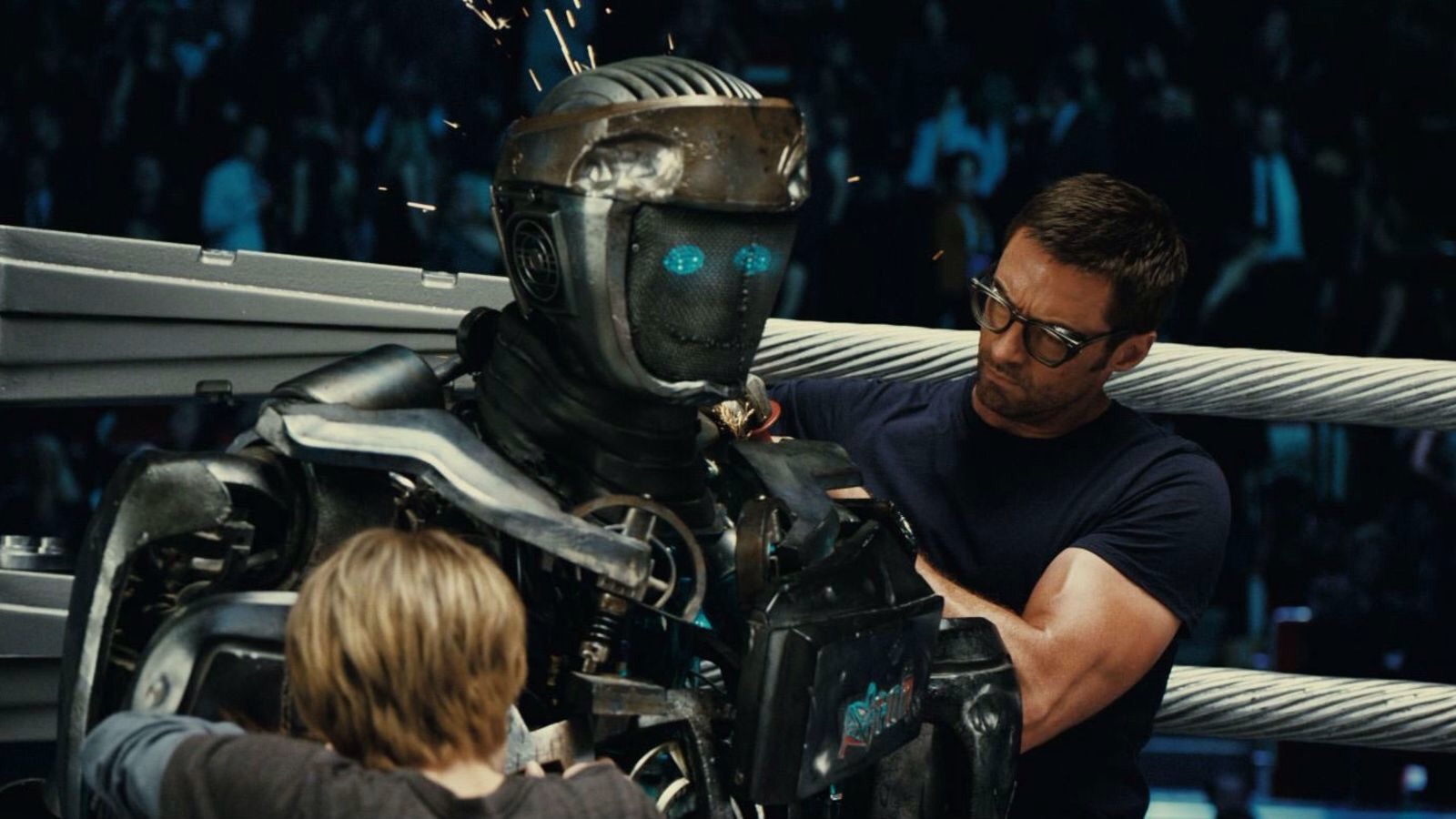
Robotic fighters have long been a recurring theme in science fiction, and an object of fascination to males like myself who refused to grow up. From the Richard Matheson story to its adaptation in the Twilight Zone episode “Steel,” inspiration was drawn for the Hugh Jackman movie, “Real Steel.” As an enabling step towards realization of those fantasies, we also have airing on The Discovery Channel the BattleBots series, a place where the pugilistic arts meet high technology in an arena of mechanical mayhem.
Now the tone of these different sagas varies greatly, with Steel as shown on The Twilight Zone dark and dystopian, and set in the then-distant future world of…(gasp)…1974! Good ole Battling Maxo could no longer hold his own against the more advanced models then. Far more family-friendly was Real Steel, a movie more centered upon the relationship of a father and son than upon the robots themselves. The weekly BattleBots series is a strange spectacle featuring teams of bright people from around the world who at times don costumes and whoop and yell as they yet intently field weaponized remotely-controlled devices against one another in a containing area. Their creations, often resembling lawn mowers from hell, inflict damage upon their opponents until an adversary is unable to operate, or time for a match runs out. Although not choreographed, matches borrow from “over-the-top” traditions of professional wrestling, complete with a ring announcer, commentators, and a whipped-up audience waving signs…
…Now, it might be interesting to see some cross-over action on BattleBots, such as seeing those ‘bots versus a Cylon from Battlestar Galactica, or perhaps a Dalek from Dr. Who.- – That ought to drive up the old ratings!
The Strange Evidence series on the Science (SCI) channel is one of the better shows currently televised on unexplained phenomena and scientific speculation. If somewhat uneven and episodic, the shows have decent production values and offer commentary and opinions by scientists as well as observers of the topics under consideration. It’s a mixture of the far out and things that just might be possible; I like it!
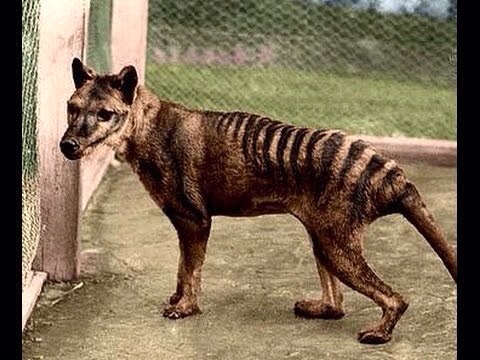
With each installment comprised of several segments, the S1/Ep10 offering included camera trap footage taken in Tasmania in 2016 of an animal unfamiliar to observers that may have been a Tasmanian tiger, a species thought to have been hunted to extinctionin the 1930’s with the last specimen in captivity (above) having died in 1936. Actually a marsupial, the Tas tiger was wolf-like with stripes and a long, inflexible tail. Due to the low resolution of the film taken, experts consulted could not conclusively identify the animal present, and thought it might have been a quoll, which is a smaller carnivorous mammal common to Tasmania.
So is the Tasmanian tiger still out there? I remain skeptical, but stranger things have happened…
Submitted for your approval is Marty, an autonomous, ambulatory robot deployed at my local supermarket to look for spills and trash. He approached me noisily from behind, beeping and flashing lights, and at first I didn’t know what was going on! Was someone pushing this thing, inside it, or remotely controlling it? — Nope, nope, and nope…but you don’t have to fearMarty. They pasted on those ridiculous, googly eyes so as not to project a Darth Vader vibe, although that might be interesting…
Vader ‘Bot: “I find your lack of fresh produce purchases disturbing…”
Customer: “Alright, just stop force-choking me, jeez! I’m throwing in cabbages, see?”
Vader ‘Bot: “The General Manager will be pleased, but pray you do not require a further demonstration…”
While it will be some time before Rosie the robot from The Jetsons will be among us, the ‘bots are coming! Marty is far from being C-3PO, but give it another ten years or so, and they could be seeking a piece of your action…
There are worse things to do to an octopus than make them high; like eating them, perhaps. Octopuses are also normally rather antisocial creatures to the extent that they’ll fight each other to the death, much like Republicans and Democrats.
Their antisocial tendencies together with their intelligence made them alluring subjects to researchers at Johns Hopkins University, who environmentally exposed octopuses to MDMA, the psychoactive ingredient in the party drug ecstasy. The serotonin-enhanced octopuses were then allowed access to separate chambers in one of which resided Star Wars action figures, while the other housed an undrugged male octopus.
The drugged octopuses forsook Chewbacca and a storm trooper to go all touchy-feely on the other octopus, wanting to hang out with and touch him! Although their brains are vastly different from human, octopus behavior on the drug was similar to that of humans in terms of enhancing social behaviors. With six more arms to hug with, it must have been quite a love-in (“His tentacles seemed to be everywhere!,” she testified).
The social enhancement behaviors were seen only in octopuses given exposure to an MDMA dosage equivalent to what a human might take; higher dosage levels resulted in the creatures lying around and staring at things, again much like humans. And if you see a huggy octopus hanging around, please don’t send them my way. I’ve nothing against them, but I only party with mammals… (Octopus’s Garden by The Beatles plays in the background)
Well, campers, we had earlier reported how a large, wolf-like creature was shot and killed by a rancher in Montana, with its identity puzzling local wildlife experts, and causing a social media tizzy around the nation.– Was this creature a dire wolf?– – An unusual bear? – – A hybrid?- – Bigfoot? Following DNA testing at the U.S. Fish and Wildlife Service forensic laboratory In Ashland, Oregon the results are finally in, and our mystery wolf-like creature is…(drum roll, please)...a wolf!
Hah! – – Bet you never saw that coming! Confusion over the animal’s identity may have been caused by it’s external appearance, with the creature appearing to have short legs and big ears, but otherwise found to be a gray wolf from the northern Rocky Mountains. According to a geneticist for the U.S. Wildlife Service, physical variations aren’t unusual for animals. As with humans, we tend to have unrealistic expectations about animal appearances.
So move along, folks…nothing to see here! And there are still around 900 wolves roaming Montana…
Evolution is perhaps coolest when we can discover examples of its transitional phases, and this little guy whose cranium was discovered nearly intact in Utah fits that bill. Small but mighty, he weighed in at under three pounds and stood only about three inches tall. He could probably give you a nasty bite on your ankle…
Resembling fossils previously found only in Eurasia and North Africa, the 130-million year old remains indicate that the supercontinent Pangea held together for about 15 million years, considerably longer than previously suspected, allowing for the spread of early mammals such as these and for their exploration of ecological niches. Cifelliodon wahkarmoosuch here was fur covered and suckled their young but laid eggs, similar to the modern-day platypus.
Described as snout-bearing and catlike with buck teeth, the critter was discovered by accident amidst a cluster of larger dinosaur bones as they were being extracted, under the foot of one of them…ouch! Just don’t dig up your basement looking for another one…
The Tasmanian tiger or thylacine became extinct over 80 years ago when the last living specimen died at the Hobart Zoo in Washington D.C. in 1936. But with the aide of gene editing and pickled thylacine pups, scientists may literally bring this awesome creature back to life again!
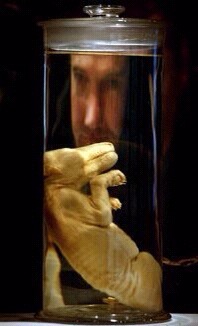
In December of 2017, scientists from the University of Melbourne sequenced the entire genome of this extinct Australian beast using thirteen thylacine joeys preserved in alcohol. Such information could within the next decade be used to bring the unique marsupial back from the dead, with gene-editing used to bridge the gap between thylacines, which have no living relatives, and other existent species.
Poor genetic diversity and overhunting by humans played roles in the demise of the Tasmanian tiger, which remain an iconic animal in the Australian imagination. The government paid people to shoot Tasmanian thylacines in the 1800’s due to fears that they destroyed sheep. Some maintain that the tassie tiger is not extinct, however, but just very good at hiding, with video footage of a bizarre hopping creature taken in North Queensland in 2015. Wildlife experts, however, remain skeptical of the grainy, unclear, and inconclusive video…
…and wouldn’t “Pickled Thylacine Pups” be a great name for a band?!







 FOXSYLVANIA
You must be logged in to post a comment.