Archive for the ‘extinct species’ category
May 4, 2010
 – – In Finland, Barney meets heavy metal in Hevisaurus, a group of long-haired costumed reptiles in leather and spiked bracelets who perform largely to kiddie audiences. Billed as the world’s only Jurassic metal band, the five performers wear elaborate costumes made of reindeer skin dyed to look green and treated to look scaly.
Metal music has gone mainstream in Finland, and is even played in churches...and if they meet Barney, I think he’ll be extinct…
Categories: creature features, extinct species, scalies
Tags: Jurassic metal
Comments: 3 Comments
March 30, 2010
 – – An image macro and one of a number of Advice Dog variations, Philosoraptor originated on 4chan with the image starting out as a T-shirt design on Lonelydinosaur.com. Philosoraptor challenges the reader with his deep, existential, and Paleolithic questions…in my book, he’s far cooler than Advice Dog!
The Urban Dictionary defines Philosoraptor as one who engages in aggressive moral or ethical debate tactics…you are alive (for the moment) when the Philosoraptor engages you in Socratic dialogue, so try to show a little respect or he will open your mind using eighty razor sharp teeth and two 4-inch sickle claws…
Categories: Brilliant but twisted, cool things, extinct species, imaginary animals, scalies
Tags: imaginary animals we like, Philosoraptor
Comments: 5 Comments
March 7, 2010
 – – How, oh how, did the dinosaurs die off?- – For many, the answer has been an asteroid impact, while others have blamed the eruption of a mega-volcano. Yet others think that they smoked too much… (Gary Larson, et al)
Well, the latest is that a “dream team” of 41 researchers from 12 nations continue to feel that the evidence points overwhelmingly to a mountain-sized asteroid more than seven miles wide impacting with the earth at twenty times the speed of a rifle bullet about 65 million years ago, leaving a 120-mile-wide scar, the Chicxulub crater, on the Mexican coast. An impact-induced environmental catastrophe ensued, with melted rock raining as far as northern Canada followed by caustic chemicals, dust, and soot filling the air, shutting down photosynthesis and causing darkness for perhaps as long as a year...major bummer!
The dinos, however, were in decline for millions of years before the asteroid strike, and the celestial hammering may be seen as presenting additional circumstances that collectively the saurians couldn’t cope with, causing 60% of all species to go extinct at that time.
…and how about a “Dream Team” of researchers?- – Can you imagine all of those pocket protectors?- -The nerdish laughter?- -The sexual frustration?!
Categories: animals, environmental, evolution, extinct species, science, strange happenings
Tags: dinosaur extinction, the Doomsday asteroid
Comments: 1 Comment
November 5, 2009
 – –Destination Truth recently had an episode with a secondary storyline line on the Arica Monster, a supposedly raptor-like creature inhabiting the Northern Chilean desert. On the desert road, people have reported seeing a dinosaur-like beast keeping pace with their cars, a neat trick. Described as large, standing on his hind legs, and having leathery skin, the beast is a fast runner with a distinctive three-toed print who attacks with razor-sharp teeth.
Destination Truth often has comic overtones that MonsterQuest lacks (remember the Mongolian Death Worms episode?), and Josh Gates and his team have such a limited budget that they are reduced to pursuing travel arrangements on Orbitz. They tend to take spills and get sick even while thoroughly enjoying themselves. As for the raptor remnant, expert opinion is that it was a rhea, an ostrich-like bird with a three-toed print…
Categories: animals, anomalies, cool things, cryptozoology, extinct species, mysteries, television, unexplained, unidentified
Tags: Arica Monster
Comments: 5 Comments
September 4, 2009
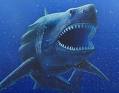 — Hmm…you go looking for a megalodon, and find…a whale shark! Somehow, the thrill is gone…
MonsterQuest went in search of a surviving megalodon shark in the Sea of Cortez in a recent offering, seeking also to better date a megalodon tooth specimen found by the HMS Challenger and estimated in 1959 to be about 10,000 years old.–Surprise! The tooth was judged not to be datable by modern scientific methods…bummer!
Now since sharks lack bones, most of what we know about extinct species comes from their teeth, with paleontologists estimating ten feet of shark for every inch of tooth. By such calculation, megalodon measured up to 50 feet long, weighed up to 50 tons, and was two to three times larger than today’s great white shark. This bad boy lived during the Miocene and Pliocene Eras, 25 to 5 million years ago.–What did they eat?–anything they wanted to, but probably seals at the small end of the scale to giant squid, other sharks, and whales…truly an apex predator!
MonsterQuest felt that most of the sightings is the area were misidentifications of whale sharks, who are just filter feeders. Some feel that MonsterQuest would have had better luck locating a megalodon in the Marianas Trench area…
Categories: animals, extinct species, rare animal, television
Tags: megalodon, The Black Demon
Comments: 6 Comments
July 12, 2009
 –When I was a kid, I had a big collection of hard rubber dinosaurs which I regarded with love and veneration. They were solid and well-detailed, not like the junk dinos often sold today. Some of the suckers were big, too, especially the one of what was then called Brontosaurus. My mother, of course, made me keep them all in a large box, mothers being well-known for their obsessive-compulsive tendencies. But every chance I had, I’d get my rubber dinosaurs out, and lovingly go over the fine details of each one. Then it was time to pit them against one another in elaborate battles to the death that occurred only in my head.–Ahh, the memories! I don’t think that kids play with rubber dinosaurs as much these days…that’s a pity! My early love for dinosaurs led me to a life-long interest in science, biology in particular.
My rubber dinosaur collection was one of my prize possessions. I knew right where they were until one day, probably when I was in college, my mother threw them out…
…and I’ve never forgiven her!
Categories: animals, extinct species, humor
Comments: 6 Comments
June 25, 2009
 –A previous post here has looked at Mokele-mbembe, but now MonsterQuest has done a feature as well. Going into the West African jungle in search of a sauropod-like creature with a long neck and tail and a small head, Mokele-mbembe is a territorial, amphibious creature known to attack humans. It is active at night, browsing on leaves.
The first written accounts of the creature came from odd claw marks found in the Congo in 1776. Pygmies are familiar with the beast, but believe that they will surely die if they report it, which puts a bit of a damper on things.
An underwater sonar survey by MonsterQuest found crocodiles, snakes, and “unusual profiles,” some of which were likely tree branches…and the dark and murky waters of the African rivers weren’t conducive to sightings. The remote location of the investigation and the politically dangerous nature of the area also hampered the search…so once again, MonsterQuest came up empty.
Our imagination or not, humanity needs great mysteries. This is yet another one of them…
Categories: animals, cryptozoology, extinct species, rare animal, science, television, unexplained, unidentified
Tags: last dinosaur, Mokele-Mbembe
Comments: 2 Comments
June 4, 2009
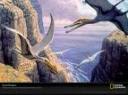 – – Do pterosaurs still exist in the 21st century?- -Perhaps in Papua, New Guinea, suggests MonsterQuest. Called the Demon Flyer or Ropens by natives, stories exist concerning the creatures going back to the 16th century. The creature is said to have killed men and scavenged graves, and may boast wingspans of over 30 feet. It is largely nocturnal, and most strangely is in some accounts said to be bioluminescent.
Now the smart money says that pterosaurs survived to the end of the Cretaceous Period, becoming extinct about 65 million years ago. Sightings of pterosaurs may be misidentified frigate birds or a new bat species. Known species such as the greater flying fox (gotta love that one!) may have a wingspan of six feet.
Not to be discouraged, MonsterQuest deployed a thermal camera and a 300 square foot bat net. The thermal camera yielded images of two campfires, and the bat net caught a blossom bat. More intriguing was a 2006 video showing two lights thought to be the bioluminescence from some creatures; analysis of the video showed that the lights were not flashlights, fires, or meteors.
While the MonsterQuest inventigation failed to yield a video of a glowing pterosaur, New Guinea is rightfully noted to be a remote island boasting amazing biodiversity and many uncatalogued species, some of which may be surprising…
Categories: animal oddities, animals, cryptozoology, extinct species, unexplained
Tags: flying monsters, MonsterQuest, pterosaurs
Comments: 2 Comments
May 26, 2009
 – – The History Channel aired a most intriguing presentation on the evening of May 25th called, The Link. It concerned possibly the oldest and most complete human ancestor, a 47 million year old fossil primate revealing an over 95% complete skeleton and even a soft body outline!
Discovered in Germany in the 1980’s, locked up for 25 years, and then secretly but intensely studied by a team for two years before revelation, this is the fossil of a small female arboreal primate less than a year old who lived in Germany in the trees of what was then an ancient rain forest. Named “Ida” after the daughter of Dr. Hurum who acquired the fossil, the fossil may be that of a transitional species, a “lemur-monkey” which captures a crucial stage in evolution, incorporating features from both the human and non-human evolutionary line.- – The fossil is visually stunning and conceptually mind-boggling!–This puppy could be big!
If this fossil is a fraud as some are already saying, it’s an extremely good one. The fossil incorporates a deformed right wrist which was likely broken and badly-healed. – -Heck, the remnants of Ida’s last meal are even represented in the stomach area! The fossil also shows a shape adaptation in the Talus bone of the foot towards assumption of an upright posture.
If a true transitional fossil or “missing link,” this discovery will likely dominate textbooks for 100 years; this could be an awesome find! As also expressed on the show, for those uncomfortable with the notion of evolution, “Ida’s existence will be a problem for many.”
Categories: animals, extinct species, furry, historical perspectives, science
Tags: evolution, Ida, Missing Link, The Link
Comments: 1 Comment
May 15, 2009
 – – The Thylacine, also called the Tasmanian Tiger, is a carnivorous marsupial presumed extinct for about 70 years. The subject of a recent MonsterQuest episode, over 350 reported sightings of the Thylacine has led some to conclude that the beast is not extinct after all! However, photographic images of the supposed Tassie have been of poor quality, and an analysis of hair samples was inconclusive; the best evidence MonsterQuest could produce was a footprint requiring further study.
Looking like a cross between a dog and a tiger, the Tasmanian Tiger by some accounts smells terrible (like rotten meat, some say) and has the uncanny ability to open its massive jaws to an angle of 120 degrees, an almost surrealistic trait documented in earlier film images. Both the male and the female also have pouches, the male’s a scrotal one. In the late 19th and early 20th centuries, bounties were offered on the creature as it preyed on livestock. Extinction came as a joint function of over-hunting, habitat erosion, and competition with other species. The last captive thylacine, named Benjamin, was captured in 1933 and lived in the Hobart Zoo until dying in 1936.
Although MonsterQuest couldn’t produce a thylacine, science someday may, with preserved specimens yielding bits of DNA that have been replicated through a process known as Polymerase Chain Reaction. The next big step would be to assemble an entire genetic library of the animal, which in turn would serve as a springboard towards reproductive cloning of the animal, likely through fertilizing an embryo in a near relative like the Tasmanian Devil…
…the outcome of that would make for a great Bugs Bunny cartoon!
Categories: animals, cool things, cryptozoology, extinct species, furry, rare animal
Tags: Tasmanian Tiger, Thylacine
Comments: 3 Comments
 FOXSYLVANIA
You must be logged in to post a comment.