Archive for the ‘environmental’ category

Giant Python Caught in Everglades

August 20, 2012

– -Burmese pythons are not native to the Florida Everglades but rather South East Asia; that fact, however, has not stopped them from becoming comfortable in South Florida, living long lives and growing to enormous size.  Such was recently demonstrated by the capture of a Burmese python measuring 17 feet, 7 inches and weighing in at 164 pounds.  The python was a female, who also is believed to have set a record by being pregnant with 87 eggs! 

What does a 17-foot long python eat?- –Anything it wants!  The snake in question had feathers in its stomach, and the species has been known to swallow animals as large as deer and even alligators.  With nothing stopping such a non-indigenous species, native wildlife are stressed and in trouble…

News With Bite, Too!

August 7, 2012

– – Talk about having a terrible, no good, really bad day!   Wallace Weatherholt, a 63-year-old airboat captain in the Florida Everglades, was giving a tour of the area on June 12th to an Indiana family and hanging fish over the side of his boat when a nine-foot alligator sank its teeth into his wrist, severing his hand.

The mutilated captain drove the boat back to its dock with one hand, and was promptly taken to the hospital.  His severed hand was found in the alligator’s stomach, but could not be reattached.  Six weeks later, the airboat captain was charged with feeding an alligator, a second-degree misdemeanor.  Arrested, Weatherholt faces a fine of up to $500 and a possible jail sentence.  He posted $1,000 bail since his arrest, and will appear in court later in August. 

The alligator was tracked down by officers of the Florida Wildlife Commission, and put to death shortly after the attack.  Laws against feeding alligators are intended to protect both animals and humans, as alligators when fed lose their fear of humans…

Shark Pursues Kayak Near Cape Cod!

July 10, 2012

– – You could practically hear the theme from Jaws playing, and a kayaker almost wound up as shark kibble in a real life drama that played out off of Nauset Beach near Cape Cod, Massachusetts recently.

One wonders what thoughts ran through the head of first-time kayaker Walter Szulc about 100-150 yards out in the water when he turned to see a shark’s fin closing on him about ten feet away.   A surfer was first to point out the shark, and hundreds of helpful people on the beach were yelling, “Paddle, paddle, paddle!”  Ironically, Szulc had teased his young daughter a short time before about being afraid to go into the water due to fear of sharks, assuring her that the risk of such was very low.–Well, paddle was what he did, “like no tomorrow,” and Szulc’s escape from the 12-to 14-foot long great white shark  was successful.

This was the third great white sighting in Cape Cod in the past couple of weeks.  Experts feel that sharks are being drawn to the area because of a spike in the gray seal population, which has grown from 10,000 to more than 300,000 due to protections being put in place.


Owl Abandonment…

May 29, 2012

– – Too many people tend to adopt exotic animals as part of a spur-of-the-moment craze, only to abandon them when the realities of their ownership hits home.  Sadly owls are one of the latest examples of this trend, with their popularity spurred by the Harry Potter movies and Harry’s owl, Hedwig. 

Now owls can live for twenty years and take a lot of care, including ideally a 20 foot aviary.  They need to be able to flap their wings multiple times before landing on a perch, or they may get a chest infection.  In spite of this, some have tried to keep them in apartments, becoming additionally distressed at the amount of feathers and droppings generated by the birds.  The result has been that in England and elsewhere, hundreds of pet owls have been abandoned and released into the wild, where they either starve to death or at best take over territory inhabited by smaller wild owls.  Owls are also winding up at animal sanctuaries in significant numbers where normally they would be relatively rare.

Harry Potter author JK Rowling has pleaded with fans not to keep an owl as a pet, urging them instead to sponsor an owl at a bird sanctuary where they may be secured a healthy and happy life…


FedEx’s “Enchanted Forest!”

May 22, 2012

– – The Enchanted Forest as envisioned by Psyop in a recent commercial is a wondrous place indeed, filled with sprites, smiling trees, and a variety of dancing, costumed anthropomorphic animals.  There’s even a fox, a remarkably tall and slender specimen wearing shorts and a top hat!  It’s essentially an environmental plug for FedEx clad as a fairy tale, and when those conventions are stripped away, we’re then left with electric trucks, recycled shipping materials, and lower-emission planes as FedEx’s contribution to the environment. 
The spot is 80% live action and 20% CGI at the onset, with an actual forest having been filmed in Washington state on the northern Pacific Coast.  The look is magical but not overly cartoonish, with a sing-songy soundtrack composed by a musical collective called Human which would be “perfectly at home in a 1950’s-era animated film,” according to the spot’s Senior Creative Director/Copywriter.  The animated characters are all fully CGI, and a wealth of fine detail may be seen in successive viewings of the spot, such as the fox character modestly covering himself when his outfit is taken away…

Attack of the Killer Shrimp!

May 2, 2012

– – Some people have bucket lists of things that they want to do before they “kick the bucket,” that is, die…but I have a list of things to be worried about or afraid of, and I’ve just added something to that list…Run, ’cause there’s an invasion of Asian Tiger Shrimp!  I can see a Saturday night movie on the SciFy channel coming out of this, folks…

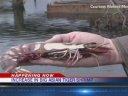
Now Asian Tiger Shrimp are not hideous mutants or skilled in the martial arts, although I could see them developed as potential adversaries for the Teenage Mutant Ninja Turtles. They are, however,  jumbo shrimp, which as George Carlin pointed out was an oxymoron.  These are big suckers, measuring up to thirteen inches long and weighing up to a quarter pound, and they are cannibalistic…that’s right, shrimp that eat other shrimp.- -Isn’t that redundant?

Also known as tiger prawn, the black-and-white striped creatures are showing up in the Gulf of Mexico and Southeast coast, and are preying on smaller, native sea life as well as competing for resources and carrying  diseases…a triple threat, if you will.  Scientists don’t know exactly how the Asian variety got to the Gulf Coast, but marine ecologists are looking into the shrimp’s DNA for clues, with breeding in the local waters or conveyance by ocean currents possibilities.

And if Asian Tiger Shrimp team up with Asian Carp, we could have seafood that would eat you…or at least take your computers for their young!  I’m paying protection money while I still can…

Mountain Lions in Connecticut!

June 14, 2011

 – – Mountain lions are said not to exist in Connecticut.  The problem is, however, mountain lions don’t read, and nobody thought to tell them; they just don’t appreciate that the nearest confirmed population of their kind is in Missouri.  As if to reinforce to one mountain lion that he was extinct, an SUV plowed into one on the Wilbur Cross Parkway earlier this month.

Now where do non-indigenous species come from?  Most likely, a rather lively trade in wild animals that is fueled by the internet.  While some states have laws prohibiting private ownership of non-native animals such as big cats, bears, wolves, and chimpanzees other states do not…and this patchwork quilt of different laws from state to state allows the irresponsible to travel to nearby states to make exotic animal purchases.  Sadly, illegal trafficking in exotic animals is a global business worth up to $20 billion annually.   A lot of the local exotic animal trade is fed by zoo or circus surplus,  the descendents of those animals, or from breeders. 

The eastern mountain lion slain may have been held in captivity, and either escaped or was released.  Irresponsible human behaviors continue to claim animal victims in this manner…

(…tip o’ the pen to carycomic!)

Coyote Attacks and Fear of Foxes

May 23, 2011

 – – Red foxes at times have an image problem; you know, that whole “crazy as a fox” thing and the business about leaving a fox to guard the henhouse.  In the minds of some people, foxes have also been tainted because of being incorrectly associated with coyotes, our larger canine cousins who can do some nasty things.  There were some coyote attacks in the state of New York last year.  Outweighing us handily, coyotes will also prey on foxes, and push us further into suburban subdivisions; they’re well supplied by Acme.

For the record, foxes don’t want to eat the  kids or pets of suburbanites; we do have our standards, after all!  Fox kits are born in late winter to early spring, when they come out of their dens to frolic ( lurking doesn’t come until much later with advanced training).  Because of the unpleasantness with coyotes, some people wig out when they discover fox families non grata in their yards.  Foxes adapt to suburbia quite well, and can find cover in hedges, under sheds, and in old woodchuck holes; we’ll even use more than one den.  Small rodents are a food source, although we’ll eat lots of other stuff as well. 

People needn’t panic, however; we’ll disperse if given a grace period or made uncomfortable; putting a chair or wheelbarrow near the current home might do the trick.  A State Department of Wildlife Conservation biologist suggests placing a radio near a fox den if you don’t want them about. 

Elevator music would send me packing in short order!

Stun Gun Hunting?

April 14, 2011

– – As technology continues to advance, it can lead us into ethical considerations previously unconsidered and perhaps unexplored that were in the past gray areas at best.  One such area is that posed by the possibility of the stun gun hunting of animals...

The value of Tasers and other electronic stun devices has been well established in police work and security applications as a non-lethal way of subduing and controlling non-compliant suspects.  Likewise, one can readily see the potential value of a Taser Wildlife Electronic Control Device such as has also been developed as a non-lethal way of immobilizing wildlife that has perhaps blundered into a human habitation area where its presence poses potential danger both to the animal itself as well as to humans present.  This non-lethal weapon can temporarily incapacitate moose, bears, and other large animals, and could be helpful to park rangers and wildlife officials; it’s a heavy-duty device which packs quite a wallop and costs about $2,000.

A disturbing question that has arisen is whether such a weapon might be used deliberately by private individuals seeking to practice “catch-and-release” hunting.  While it is unclear whether stun guns have already been used for this purpose, the potential for such abuse is real.  While stunning an animal without need is preferable to shooting it, such an action could easily be considered cruelty.  Human test subjects who have experienced stun guns almost universally describe the experience as painful and unpleasant, and the United Nations considers stun guns instruments of torture as they inflict pain.

The state of Alaska is accordingly moving to proactively outlaw the use of stun guns to zap wild animals for “catch and release” hunting in the state.  The weapon may still be used defensively, in emergency situations, or for purposes of further research by trained professionals.  State biologists have been using electronic animal control devices in Alaska since 2005.  Additionally,  while wild animals usually flee when hit with the current, there is no guarantee that they will do so…and one does not want to severely aggravate a grizzly!


Oh, the Fishies!

March 9, 2011

– – Once again, another mass fish-kill has occurred, this one in Redondo Beach, California.  The fish are mostly sardines and other small fish, thought to number in the hundreds of thousands; so massive are their numbers that the carcasses are about a foot deep on the surface!

Biologists have tentatively concluded that the fish died of oxygen deprivation after being driven by a storm into a closed-off pier area, basically swimming in the wrong direction and ending up in an area with insufficient free-flowing oxygen in it.  There is no sign of oil, chemicals, or illegal activity.

Seals and other fish are gorging themselves, while humans are using buckets and nets to remove the approximate one million deceased fish, which will be taken to a landfill specializing in organic materials…