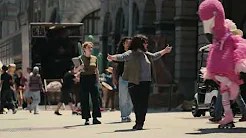
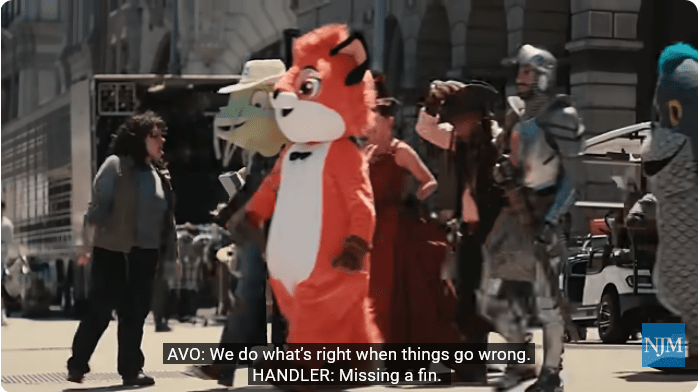
NJM Insurance had earlier in a commercial shown us a tourist tram pulled aside in a backlot to observe a mascot commercial being filmed that involved costumed shark mascots, and now we are shown the same busy backlot where a number of mascot commercials are being filmed, necessitating a kind of traffic control function to stop pedestrians in order to allow mascots to pass…
…and a glorious and diversified mascot parade it is, too! There’s some kind of roller skating flamingo, what appears to be a catfish, my favorite, a fox, and a number of others. Themascot handler shouts corrections and admonishments to the mascots as they pass, such as “missing a fin,” and “get to it, fox!” Normally, we foxes would consider such comments rude, but work is hard to find…
The NJM commercial of course is to proclaim the fact that their company does not have mascots or jingles, but just great insurance…
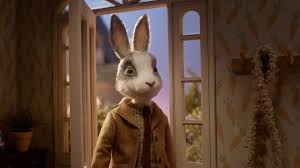
Rabbits sure can multiply; employ algebra and calculus, not so much. And so when Papa Rabbit enters his home, he finds it jam-packed with his progeny, all moving about and enjoying internet-dependent activities like gaming, streaming, and on-line learning. Papa Rabbit desperately needs to run an internet search on “birth control…”
When Papa Rabbit manages to weave his way around the legion of offspring and trudge upstairs to see his missus, she is knitting tiny infant outfits, a universally-understood sign that she has a “bun (pun intended) in the oven,” three actually…but then, Momma Rabbit flips the top row to show that she has prepared six tiny outfits!
Papa Rabbitis devastated, his eyes big as saucers and his jaw dropping! Guess it’s too late for a vasectomy now. Good thing that Xfinity will lock in his internet price for five years, because he’ll need every bit of money he can muster to maintain his growing brood…
The commercial is rendered in the stop-motion style of Fantastic Mr. Fox, which lends a certain charm.Otherads in the Imagine That series have featured the Frankenstein monster and Jeff Goldblum.Thesong playing is The Green Grass Grows All Around, performed here by Louis Jordan…
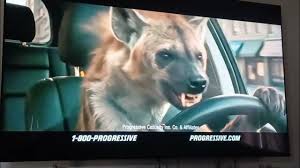
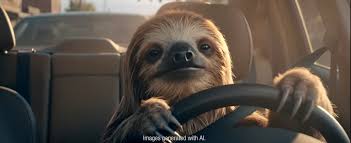
In a CGI Progressive Insurance commercial, we are shown animals driving. Human nature is seldom seen at its best when behind the wheel of a car, and the roadways can truly be seen as a jungle of sorts. The question that then emerges is, What kind of animals will you encounter while driving?And inevitably, What kind of animal are YOU when driving?!
We can largely imagine how a sloth might drive, but how about a deer? They freeze in headlights, of course! A lion drives ferociously, roaring and embodying road rage. Hyenas laugh as they zip across lanes. A ram drives true to his name…
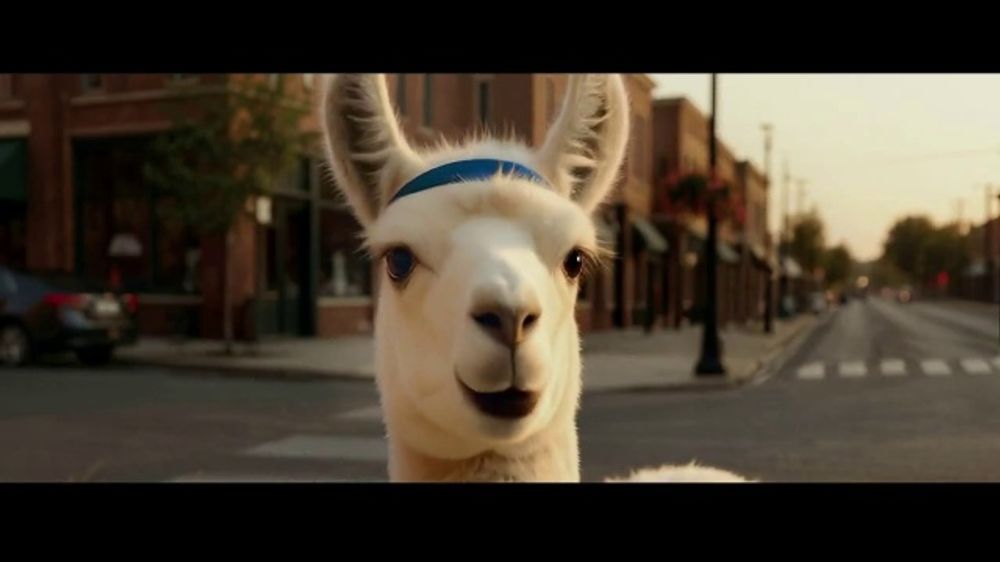
And not to be forgotten,Progressive’s own spokesperson Flo voices a llama safely from curbside, reassuring that with Progressive that you won’t be held responsible for other people’s mistakes. In a reference to another llama commercial featuring a llama at a hairstylist, she asks also if people are staring at her because of her hair…
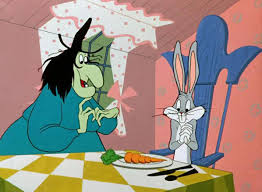
With Halloween nigh, I thought it might be appropriate to pay a Foxsylvania tribute to Witch Hazel, one of Warner Bros. mildly darker characters lightened by her humor and self-parody of witches in general. Witch Hazel is almost reminiscent of the Warner Bros. character of Granny, but turned slightly to the dark side…
Created by Chuck Jones in 1956, Witch Hazel was reportedly inspired by the witches of Shakespeare in Macbeth, but considerably more comic. Viewers knew that Witch Hazel would never actually eat children, nor defeat Bugs Bunny. Hansel and Gretel did actually appear in Bewitched Bunny featuring Witch Hazel, but Bugs handily thwarted her, masquerading as a truant officer to gain access to the witch’s abode. Hazel then tried to feed Bugs a poisoned carrot, but that didn’t go as planned for her, either…he’s apparently unintentionally rescued by Prince Charming in another crossover from fairy tales!
At the end of that episode, Bugs employs an accessed magic powder to turn the witch into a rather winsome female rabbit, walking off arm in arm with her. Breaking the fourth wall to address the viewing audience, Bugs informs us that he knows that this is a witch, but asks us if they (females) aren’t all witches inside! (*breath-taking gasp!*) Dialogue like this would probably not pass muster in today’s politically correct age…
( I don’t care, the female rabbit is still hawt! )
I have always had an interest in and appreciation for vintage cartoons, not to disparage the modern product ( although some “limited animation” ‘toons are poorly drawn and abominable). It’s just that when we look back on some of these efforts stemming back to the early days of animation, we can appreciate how clever, wildly creative, and groundsbreaking they truly were…
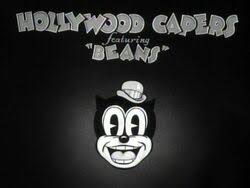
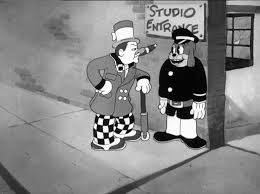
One such example is the 1935 Looney Tunes cartoon Hollywood Capers (featuring Beans). Now Beans (one of the Boston Beans, he tells us) is a black cat properly attired in overalls and a too-small hat who sneaks into a production studio, and we meet cartoon versions of Charlie Chaplin and W.C. Fields along the way.- – How sad that such classic characters are becoming increasingly unknown to many people!
Now Beans creates all kinds of mischief in the studio, even meeting the Frankenstein Monster, who was almost a current issue at the time that this cartoon was made…
So take the time to view some early vintage ‘toons, which can have the sensation of being an acid trip sans drugs. They are wildly remarkable for their time…
I, for one, think that it’s time that Warner Bros. rehabilitates and brings back Pepe Le Pew, the hopeless romantic French skunk. Created by Chuck Jones and first appearing in 1945, the character was caught in a firestorm a few years back for his signature behavior of foisting his unwanted amorous intents upon females, specifically one Penelope Pussycat…
I get it! What was perfectly laughable and largely acceptable behavior in 1945 isn’t now, and Pepe needs to be and could be re-imagined and re-introduced, perhaps as a defender of women or as a bonded mate to a now equally-loving Penelope; portray him as a chastened now successful relationships counselor, even! We just lost a lot when Pepe was banished to cartoon purgatory…
Pepe was lovable, and had a certain charm. He satirized French culture and the stereotype of the great French lover, blinded by his own misperceptions of his desirability; the joke was always on Pepe, who because of his skunk-odor wasn’t desirable, and was hitting on a member of another species entirely, failing to discriminate such. Pepe had a cluelessness that was relatable and even endearing. He never successfully scored, unless you count unreciprocated kissing as that…and face it, there are very few cartoon skunks in the field!Heck, with his repellent scent, re-brand him as a kind of superhero or police officer. Imagine, for a moment, the Pepe and Penelope crime fighting team!
So how about it, Warner Bros? Why does Pepe Le Pew suffer harsh sanctions when the Mango Mussolini does not? Free Pepe Le Pew from his cartoon prison, and re-introduce the boy as someone who’s learned his lesson, and changed! – – It can be done!
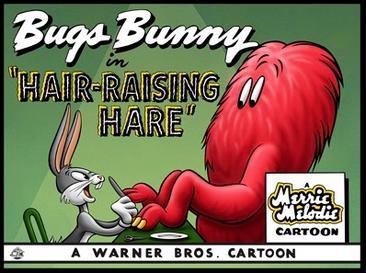
With Halloween coming, our attention turns (more than usual) to monsters, and an underrated cartoon monster is Gossamer, a creation of Chuck Jones who first appeared in the 1946 Warner Bros. cartoon, Hair-Raising Hare.Gossamer has a heart-shaped head and face, and is completely covered in reddish-orange hair, his only clothing a large pair of white or gray-white tennis shoes…
NowGossamer is a creature of indeterminate species and sex, originally intended as an antagonist to Bugs Bunny, who quickly exploits Gossamer’s attraction to girly-type things like manicures and hair make-overs. Gossamer is also handily defeated even by Porky Pig in his space-cadet identity in service to Daffy Duck, calmly using a monster hair-clipper…of Acme manufacture, of course!And surprise…Porky’s clipper reveals that Gossamer is entirely made of hair!
Gossamer is essentially a paper tiger, so to speak, and while usually a hulking giant seen lurking in Gothic-type castles or even on Mars, he actually has a hidden shy and sensitive nature, and is more scared of people than you are of him. Enjoy the following compilation of Gossamer’s greatest moments that follows, and watch for a cartoon version of Peter Lorre right at the beginning!
To my knowledge, there hasn’t been an on-going werewolf character in a regular TV series since Oz on Buffy the Vampire Slayer and Josh in Being Human. Fortunately, the Wednesday series on Netflix has introduced a leading werewolf character, a female no less, in the person of Enid, the roommate of Wednesday Addams.
Now Enid is not your typical dark and tormented werewolf character, but instead a rather cheerful and bright-spirited young lady who is just at the start of her werewolf journey, in the process of discovering herself and experiencing her first transformations. She contrasts almost completely with the darkness of Wednesday, having her half of their shared room in bright colors whereas Wednesday’s half is black and gothic. When asked at one point how she feels, Enid responds, “warm and fuzzy!”
Herupbeat nature initially causes Wednesday to keep Enid at some distance, but their relationship grows during the series, and in the second season now completed it’s revealed that Enid is not only a werewolf but an Alpha, capable of changing into her wolf form willfully without a full moon. Should she do so at this point, however, she will be permanently locked into her werewolf form, unable to transform back to human status…
Well, it turns out that when Wednesday is prematurely buried by a series villain and in danger of death by suffocation, Enid’s powerful werewolf form is needed to excavate Wednesday from her grave just in time. Fearless and unshaken, Wednesday declares “I enjoyed that” of her burial experience; you gotta love this dark girl! Enid, however, is locked in her werewolf form and feral, and goes on the lam. She is pursued by (hooray!) Uncle Fester and Wednesday at the end of the second season, with Wednesday riding in the sidecar of Fester’s motorcycle, and Fester ecstatic about the fun they’ll have pursuing such a dangerous creature!
Itwill be interesting to see the further development of Enid’s werewolf character, who Wednesday promised to pursue and restore. One hopes that Season 3 of Wednesday will not be long in coming…
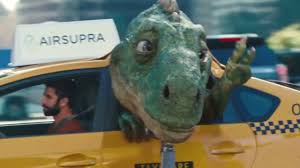
A mini-dinosaur might make an interesting if cumbersome pet, and of course they’d have to be well-behaved! With a name like Walter, this diminutive T-rex sounds rather domesticated, but he’s still awfully big for human environments, and so can barely fit into things like elevators and taxicabs…
Asthma medications haven’t changed much in fifty years, you see, so the albuterol inhaler is really a dinosaur of sorts. Walter is then a metaphor representing older, outdated “rescue” albuterol-only inhalers for asthmathat primarily treat symptoms of asthma without addressing underlying inflammation. Airsupra is a “dual-action” inhaler that treats both symptoms and underlying inflammation of asthma…
So Walter is awkward and outdated on tandem bikes, being, after all, a dinosaur. We’re unlikely to see him in any of the Jurassic Park movies either, which is a pity because he does appear genial and is cute…
If you’ve noticed, we now see Earl the Cat from the Smalls cat food commercials mostly as a simplistic two-dimensional line drawing these days. Rarely do we see the wonderful Earl as the guy in the fursuit anymore…
This is a shame, because fursuit Earl is far more captivating than line drawing Earl. He was so good and compelling that his presence probably distracted from the cat food product itself.There are other examples where a commercial character was so magnetic that they apparently distracted from the product being advertised, and so were sadly phased out. I just think that we had yet to see the best of fursuit Earl…
ConsiderLactose Cow in the Lactaid commercials, aka “the Milk that Messes With You.” Mess with us she did, but was incredibly comic and memorable in doing so, far outshining the demure blue-and-white Lactaid Cow. I for one deeply miss seeing these commercial stars, and since I am powerless to return them, will leave you with a few memories of the best of The Milk That Messes With You. Characters gone but not forgotten…*sighs*












 FOXSYLVANIA
You must be logged in to post a comment.