
Archive for the ‘science’ category

Mr. Toad’s Wild Ride…

March 31, 2010

– – Anecdotal accounts have existed for thousands of years of animals foreseeing natural disasters such as earthquakes; birds, dogs, snakes, cows, and other creatures have been attributed with such abilities, while documentation could not be reliably made.

A pair of behavioral biologists, Rachel Grant and Tim Halliday, have recently documented proof in the current issue of the Journal of Zoology that large numbers of toads fled a breeding area five days before a magnitude 6.8 earthquake struck L’Aquila, Italy in April of 2009. With weather variables such as temperature, humidity, wind speed, and rainfall normal,  it is speculated that the toads may have picked up on environmental signals prior to the earthquake such as foreshocks or changes in naturally occurring magnetic fields that encouraged them to flee.

Scientists who are already studying amphibians in earthquake-prone areas such as Indonesia are being looked to in order to determine if the behavior occurs again...listen to the animals, humans, or ignore them at your peril!
Bee-Venom Therapy?

March 20, 2010

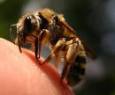
– – I, for one, don’t like being stung by insects, and have gotten more than enough of that while mowing the lawn.   There are those who think, however, that being stung by bees is good for what ails you, including conditions such as arthritis, tendonitis, multiple sclerosis,  fibromyalgia, irritable bowel syndrome, and even depression. – -Hey, let’s go out and get stung!- -That ought to give us a lift!

Now believers in apitherapy don’t wait for random insect attacks, but rather tend to use groups of up to 100 honey bees raised for the purpose.  Self-treatment seems to be common, while more formal treatments are offered in the orient for the equivalent of about $18.

Does it work?- – Persuasive personal testimonials are out there, but so are sightings of aliens and Bigfoot.   Supportive research studies are few and far between.  Studies in Greece and South Korea have shown anti-arthritic effects in mice, which of course we like to see lively and flexible.  Most results are not conclusive, and while the benefits of such therapy are uncertain, the dangers are clear with about 2% of the population susceptible to allergic reactions from the stings of bees and wasps.   Those considering a full bee barrage should also consider the fact that your body tolerated the first 99 stings doesn’t guarantee it can handle the 100th…

The Dino Dilemma…

March 7, 2010

– – How, oh how, did the dinosaurs die off?- – For many, the answer has been an asteroid impact, while others have blamed the eruption of a mega-volcano. Yet others think that they smoked too much… (Gary Larson, et al)

Well, the latest is that a “dream team” of 41 researchers from 12 nations continue to feel that the evidence points overwhelmingly to a mountain-sized asteroid more than seven miles wide impacting with the earth at twenty times the speed of a rifle bullet about 65 million years ago, leaving a 120-mile-wide scar, the Chicxulub crater,  on the Mexican coast. An impact-induced environmental catastrophe ensued,  with melted rock raining as far as northern Canada followed by caustic chemicals, dust, and soot filling the air, shutting down photosynthesis and causing darkness for perhaps as long as a year...major bummer!

The dinos, however, were in decline for millions of years before the asteroid strike, and the celestial hammering may be seen as presenting additional circumstances that collectively the saurians couldn’t cope with, causing 60% of all species to  go extinct at that time.

…and how about a “Dream Team” of  researchers?- – Can you imagine all of those pocket protectors?- -The nerdish laughter?- -The sexual frustration?!

Seen Any Aliens?

February 21, 2010

– – Have ‘ya seen any aliens lately?–No, not the illegal immigrant types, but rather the extraterrestrial variety.–Well, if you have, you may wanna hook up with setiQuest

Now SETI of course is an acronym which stands for the Search for Extraterrestrial Intelligence, and setiQuest adds a community involvement component, an effort to tap into the global brain trust and harness the power of citizen scientistsIf you have the chops, you can participate as a software developer or signal detection algorithm developer, or simply help sort through data received from such programs. It is felt that a more global community can more rapidly discern and sort through anomalous signals in search of the proverbial needle in a haystack that might finally alert us to E.T. – – very cool stuff to be rolled out in the next year or so!

Obsessive-Compulsive Disorder in Dogs

February 7, 2010

– – Not only Good Time Charlie gets the blues; canines do, too!–Well, at least they seem to be capable of obsessive-compulsive disorder…

…the January issue of Molecular Psychiatry reports that scientists have located a gene for obsessive-compulsive disorder among certain canine breeds, especially Dobermans and bull terriers.  Up to 70% of some litters have OCD tendencies, compared to only 2% in the human population.  In canines this might be behaviorally manifested by such things as chasing their own tail or sucking on their own body parts.

Dogs with such behaviors are more likely to express a CDH2 gene.  Located on chromosome 7, that gene mediates communication between neurons in the brain.  The gene is located in the hippocampus in both humans and dogs.

So why should you care?–Well, the canine-human link could lead to preventive medicine and better treatment for obsessive disorders in both species.  The CDH2 gene may also be implicated in autism spectrum disorder as well.  The National Institute of Mental Health is conducting its own study, looking for the CDH2 gene in blood samples of human OCD patients; this would be the first confirmed psychiatric gene in humans, possibly with others to follow.

Neuropsychiatry promises to be a real growth field in the future, or so this fox thinks, and I’m crazy like one…


SETI Faces More Difficult Task

February 1, 2010

– – The Search for Extraterrestrial Intelligence may have gotten more difficult as communications technology improves, and the Earth becomes “quieter” as a result…

…Earth used to churn out a loud mess of radio waves, television signals, and other radiation, but more communications traffic is now relayed by satellite and fiber optic cables, which  tends to limit the “leakage” of such signals into space.   The recent switch from analogue to digital television also uses a far weaker signal.  If similar processes are taking place in other technologically-advanced societies, they too are presumably becoming quieter and would be more difficult to find.   Additionally, alien cultures might have a bad impression of us from exposure to shows sent their way such as Gilligan’s Island.

A new avenue for contacting ET might be to use lasers to send ultra-bright flashes of light into space for mere fractions of a second.  Such pulses could theoretically be seen by advanced civilizations up to 1,000 light years away, with infrared versions of such devices capable of sending beams even further.

This of course presupposes that alien civilizations would want to get in touch with us to begin with!

“Wolf Moon” Tonight!

January 30, 2010

– – The full moon on the night of January 29th will be the biggest and brightest full moon of the year.  It is also known as The Wolf Moon, a name dating back to Native American culture and the notion that hungry wolves howled at the moon on cold winter nights!  What a beautiful image…except for the wolves being hungry, of course!

Tonight, the moon will appear 14 percent wider and 30 percent brighter than lesser full moons of the year, which is caused by a full moon coinciding with the moon reaching its perigee, or closest point to us...

…so have yourselves a howling good time!

Animal Testing Alternatives

January 20, 2010

– – Controversial animal testing for cosmetics manufacturers could soon be replaced by a new technology which uses laboratory-grown human skin cells to simulate the body’s allergic  response to foreign chemicals.

The standard method for testing allergic reactions involves applying chemicals to the ears of mice or guinea pigs, which are later killed and dissected for study.- – Kinda a “no-win” situation for rodents…

The new method would use a glass chip with human skin cells and chemicals which simulate the body’s immune system.  When a foreign substance is dropped onto the chip, the cells and chemicals interact to mimic the human’s body’s natural allergic response.  A working prototype by Hurel Corp. funded by L’Oreal is in the works, and could be in use by next year…

Living Green!

January 14, 2010

– – Part plant and part animal, a sea slug found living in salt marshes in New England and Canada called Elysia chlorotica is the first multicellular animal found to be able to produce the plant pigment chlorophyll.   The critters can actually survive without food if a light is shined on them for twelve hours a day.- -Now that’s walkin’ on sunshine!

The slugs appear to acquire this ability by stealing genes from algae that they’ve eaten, stealing also minute cell parts called chloroplasts which enable conversion of sunlight into energy.

The slug has been studied for about twenty years, although scientists are not yet sure how the animals appropriate the genes that they need.  This is yet another example of how invertebrates can do some pretty amazing things…well, let’s see you live without food!    😉


Getting Enough Worms?

January 12, 2010

– – In the earlier 20th century and prior to that time when dirt roads, horses, and cattle were more prevalent in life than they are now, every child and adult had worms in their gastrointestinal tract!  These worms were part of the ecosystem of the gut, and aided in controlling human immune reactions in order that they might live successfully in people. In the last 100 years or so, a more hygienic environment was created for people which led to immune disregulation, and so, one theory would have it, to an increase in certain immunological diseases.  A more sedentary lifestyle and a lack of physical activity also renders people more prone to certain illnesses and ailments to a degree not seen in the past.

Such immunological and metabolic diseases and conditions may include multiple sclerosis, type I diabetes, asthma, obesity, and even hay fever (now suffered by 1 in 4 people in the United States).  Improvements in hygiene have reduced infections, but along with that have reduced exposure of the immune system to antigens, such as compounds from viruses and bacteria.  Bodily regulation mechanisms then tend to become less effective, and certain illnesses and conditions are suffered to degrees not seen in the past.

(…but I’ll still pass on the worms, thank you!)